Started 20 July 2013
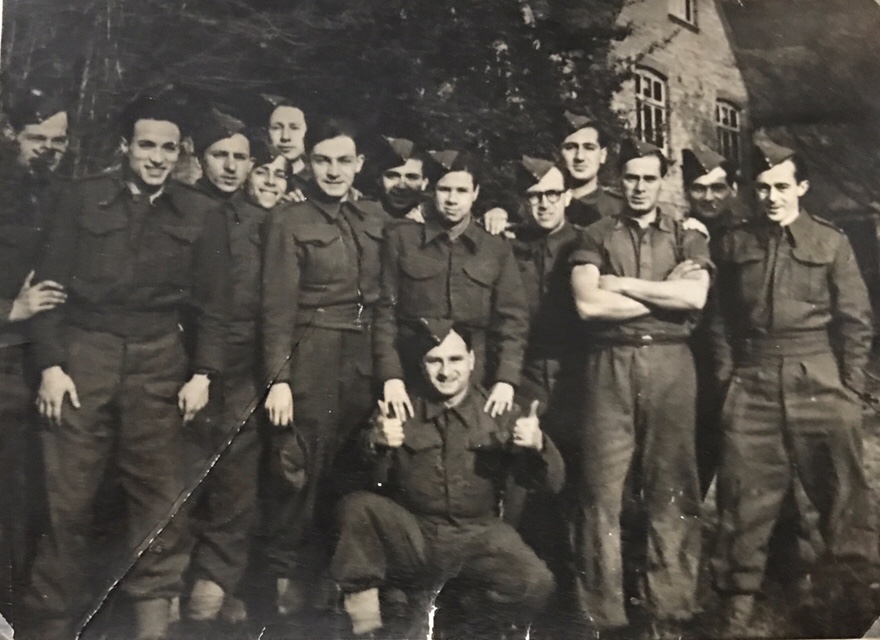
Dad was always pretty vague about his war, apart from a few often repeated yarns, – the occupation of the brewery in Pilsen, etc – and reading up what I can find about the Czech Armoured Brigade on the internet would explain why. It seems that they (4000 officers and men) were under the command of the 1st Canadian army at the time and they crossed to Normandy on 30 August 1944. They arrived at (fought their way to?) the “besieged fortress” of Dunkirk on 6 October and stayed there, besieging Dunkirk until the Germans there finally surrendered on 9 May 1945, the day after the end of the war.
For more details, see:
http://en.wikipedia.org/wiki/Siege_of_Dunkirk_%281944%E2%80%9345%29
and http://en.wikipedia.org/wiki/1st_Czechoslovak_Armoured_Brigade
So my dad’s active service was just that, besieging Dunkirk. It seems not just to have been just sitting there and waiting. There were a series of attacks and counter attacks by both sides. I once asked Dad if he ever had any really dangerous moments in the war, and he said once he was driving a military truck and the person sitting next to him in the passenger seat was killed by sniper fire. So that could only have been during the siege of Dunkirk.
Once, at the start of our holidays in the early 1950s, we were staying overnight in St Omer, the first sizeable town heading south-east from Calais, (in the Hôtel Grand St Louis) and Dad went off on his own, saying he was going to Esquelbecq, a nearby village. He gave no explanation but Esquelbecq is just 19 km from Dunkirk, so maybe that was where he had been based. He was quite solemn when he set off and when he came back, and we assumed he had been to a military cemetery to visit some of his comrades’ graves. (Quote from the Wikipedia entry on the Czech Armoured Brigade, “During the siege of Dunkirk, the Czechoslovak Armoured Brigade suffered 668 casualties; 167 dead, 461 wounded, and 40 missing.”). There is an article about the Czechs at the siege of Dunkirk, (ref: http://www.nasenoviny.com/DunkirkEN1944_45.html ) which lists the cemeteries where the Czech army dead are buried; there are none in Esquelbecq; however, the Czech headquarters were in the canton of Wormhout, which includes the village of Esquelbecq. Wormhout is south of Dunkirk and well out of the range of the German guns in Dunkirk.
For me the best thing was that, as I recently found out, there was a French factory owned by the Meccano company that stayed in production during the war. So all through the war and for some time after, Meccano sets, like most other decent toys, was completely unobtainable in the UK, but there were Meccano sets being manufactured and sold in France. Anyway, one day, I guess in the post, I received a number 0 Meccano set, the smallest there was, sent by my dad. Indescribable joy! Some time later a No.0a set arrived, the pieces needed to convert a No.0 set to a No.1, then a No.1a set, later a No.2a, later a No.3a, by which time that made a full No.4 set. Magnificent! I played with that Meccano for hours and hours during, I guess late 1944 and early 1945, when I was 8, and for a good time afterwards.
The fact that my dad was besieging Dunkirk and not battling his way across Europe explains a lot of things apart from the regular arrival of Meccano sets. Dad was regularly asking my mother to send him more cigarettes, lots more, and, as she later explained, she kept thinking that he should not be smoking so much. But of course, he was not smoking them. Cigarettes were the best currency, you could buy anything with cigarettes, not just Meccano sets, but watches, food, clothes, anything. Dad must also have come home on leave occasionally; he was on leave with us on the day the war ended on 8 May 1945; that day a telegram arrived for him telling him to return to his unit immediately, no doubt because they were getting ready to move on from Dunkirk. Once he brought us a tiny tin of Nescafé, the latest wonder of the world, instant coffee, just newly invented. Seemingly the Swiss war effort.
So then the Czech Armoured Brigade, reorganised to include among others, three tank battalions and a motorised infantry battalion, made its way to Czechoslovakia. I don’t know which or what sort of battalion my dad was in. There’s not much in the way of memories, except that they crossed Germany and Dad had a certain satisfaction in seeing the smashed up German cities and towns, and that the German people were having a hard time. There are plenty of photographs taken by Dad between the departure from Dunkirk in May 1945 and his demobilisation in Czechoslovakia in the September, all undated. I remember his saying that at a certain time he was driving a 3 ton Dodge truck. I’m not sure whether he was ever part of a tank crew. I can remember him calling his bit of the Czech army the Field Park, but I don’t know what that meant.
Otherwise, there’s the mention of occupying the famous brewery in Pilsen; he took part in a victory parade in Prague, at one time he was in Vienna, and in particular he said that he was with a group who had “occupied”in the Hotel Sacher (very posh). He went to our pre-war flat and saw people he’d known, but I can’t remember who. He saw Hilda who had stayed in our flat and who told him that after we’d gone, the Gestapo came to arrest us and she had the satisfaction of telling them that we’d gone.
On his way back to England after his demob he managed to go through Amsterdam and to see Fritzi and Eva. He was in Czechoslovakia from May to September 1945, so about four months, but I don’t know what he was doing. Certainly all the bits of Czech army that arrived, notably the part assembled in the USSR and the part from the UK were merged into one Czech army.
There were probably quite a few people like himself wanting to get back to the UK, but it seems that nothing had been organised in the way of transport. In fact he organised his return himself, cobbling (not to say forging) the various documents and vouchers together himself. This was a long complicated yarn which I never fully (or even partly) understood. He got himself flown home in a Douglas Dakota with a handful of British officers, all highly irregular. And that was the end of that.
Below, some photos from Dad’s wartime photo album.
Here on the left are photos of Peter and Dad, just entitled “Little men, big tanks”, no date or place.
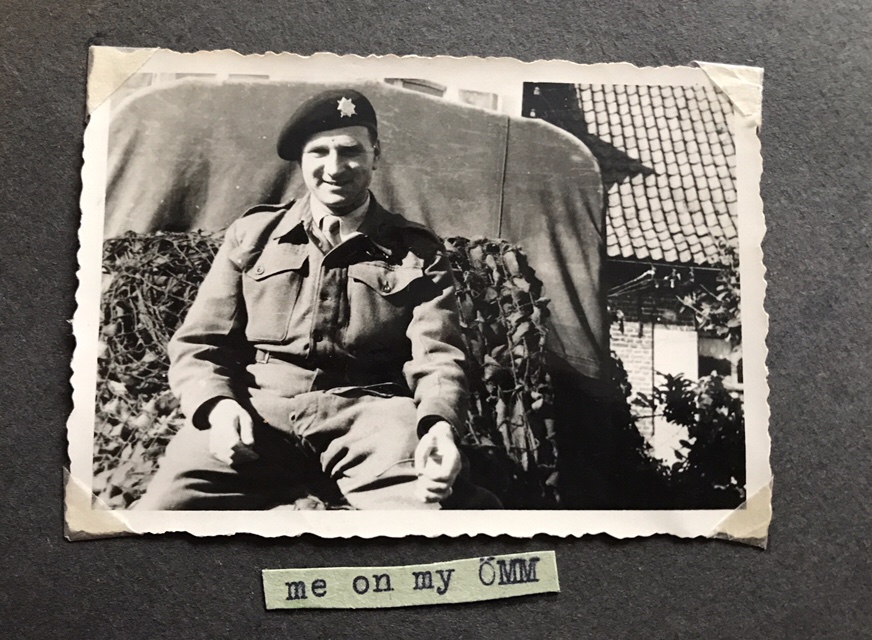
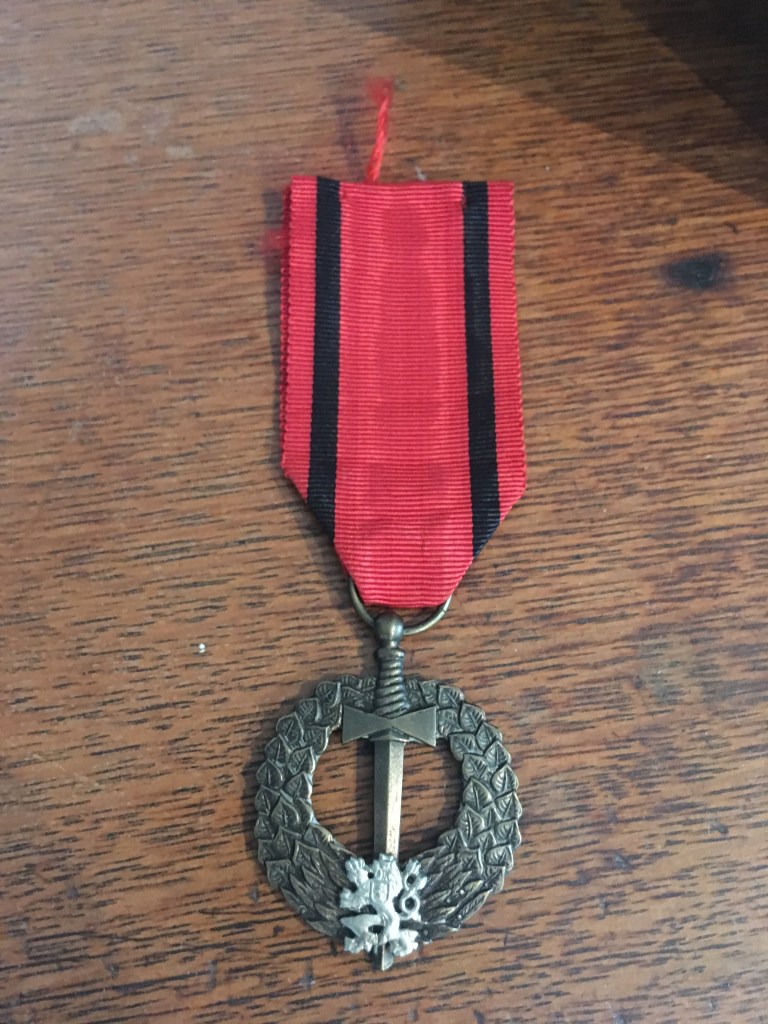
And below, two photos taken in Esquelbecq. The left one is entitled “Zurek and me in Esquelbecq”; On the back it’s dated March 1945, and it says, “Zurek, me and O.M.M.” The other photo is entitled, “Me and my OMM”, and on the back, “Sitting on my Dodge”, so it seems that the OMM is a smallish Dodge vehicle.
The album includes several pages of grisly photographs taken by Dad in Czechoslovakia showing the remains of 42 Czech political prisoners who had been murdered in April 1945 by the Gestapo and the SS, being dug up and cleaned by German prisoners; then photographs of the burial service. After that, lots of photos travelling through Germany and then in Czechoslovakia, some taken by Dad, some I guess not. There are no other photos of Dad apart from the above and one that I can’t take out of the album to scan it without damaging it. I think I can find it elsewhere.
Anyway, the album is here for you to look at any time you like. There are also some banknotes in the album, Belgian, French, Russian, Czech, including 10 and 50 crown (Kronen) notes from Theresienstadt, a concentration camp in Czechoslovakia, (more details on e.g. Wikipedia; it was more like a ghetto than an extermination camp, but thousands of people were held there before being sent to extermination camps).
He also took an interest in the postage stamps that were in use wherever he went, and brought quite a collection home; I’ve got them here. He also sent letters with e.g. a British and a Czech stamp stuck on, thinking that would be interesting or even valuable in the future.
So that’s the end of Chapter 7, Dad’s war Part 2, Active service.