Dad’s Memories: (Johnny writes): Until recently, I only knew fragments of the story of my great-grandfather Rudolf’s younger brother, Edmund Markovits. Some of this came through my father Tom Greenwood’s memoirs, which recorded that Rudolf had one brother – Edmund – and two sisters: Karoline (known as Lina), who became Karoline Goldschmied, and Franziska (known as Fanni), who became Franziska Loewensohn (Löwensohn in German). My father also recalled that Edmund had two sons, Harry and Freddy. He believed that both emigrated to Palestine just before the war. Harry and his family stayed there, and he suspected there might be descendants – grandchildren or great-grandchildren in Israel today. He said he knew that Freddy and his family, by contrast, had returned to Vienna after the war.
My father also remembered that Freddy and his mother Sylvia (my grandmother) had seen a lot of each other as children and always stayed in touch. In my dad’s memoirs he says Freddy was very lively and jolly, much like Rudolf. From the 1950s onwards, my father met Freddy, his wife Rena and their son Edy in Vienna from time to time. Freddy had a vending‑machine business – cigarettes and confectionery, he thought – and had become quite well off. Edy, a little younger than my father, was married to a woman called Eveline. Freddy continued working long after retirement age to help Edy with the business. The last time my father saw Freddy and Rena was in 1992, when he and my mother went to Vienna for (my great‑uncle) Peter and Lisl’s golden‑wedding party. Freddy and Rena would have been in their early 80s at that time. My father never had contact with them again.
He also remembered that Freddy and Rena had become quite well known in Viennese high society and seemed to be on friendly terms with prominent people in politics, business and the arts. Rena, he said, seemed “seriously serious and seriously posh.” Lina, Rudolf’s sister, was also remembered for her musical talent: she had been a professional concert pianist.
Meeting Florian Markovits‑Grella
In early 2024 I was contacted by Florian Markovits‑Grella, who had come across this Greenwood family history website. Florian lives in Vienna and is married to Marion, one of Edmund’s great‑granddaughters. Marion’s mother Eveline – Edmund’s granddaughter‑in‑law – also has vivid memories of the family’s history. Marion is the daughter of Edy, granddaughter of Freddy, and great‑granddaughter of Edmund. Florian has been generously researching this side of the family, sharing notes, documents and stories that transformed my understanding of what happened to Edmund and his descendants.
Edmund’s Early Life and Family
According to official records, Edmund was born in 1887 and married Sofi (“Fuschy”) Goldwurm, born 24 November 1881 in Botuschany (Galicia). The Goldwurms were a well‑connected family, and Freddy and Rena later remained friends with Jean Goldwurm of New York, a prominent figure in the film industry. Freddy himself travelled to New York in the 1950s – documents show he held a driving licence, social security number and library card there.
Edmund and Fuschy had three children: Harry (born 1919), Freddy (born 1921) and a daughter who died young. Harry trained as a mechanical engineer and Freddy was known for his outstanding ability to fix things, especially clocks and household items. The family lived in Vienna, where Freddy became close to Rena (Irene Sass, born 1911 in Lemberg, now Lviv) – not a cousin as once believed.

Pre‑War Vienna and Family Businesses
An explanation for the exceptional number of surviving photographs of this branch of the family may lie in a short-lived business venture. According to Lehmann’s Address Book[1], Rudolf and Edmund jointly operated a photo equipment shop and studio in Vienna for a few years. Their main business connection, Bruns Taxameter, was an important limited company involving instrument manufacture that struggled and was later liquidated. It appears the company was then taken over by the Goldschmied family – linked by marriage to Karoline (“Lina”) Markovits – and after liquidation by Franziska Loewensohn’s husband Löwensohn. We don’t know what exactly happened and why. One possibility might be that Markovits and Goldschmied bought the company and had to liquidate it. Maybe the company was already in trouble and therefore cheap, explaining why they bought it. We think, after just one year – during the liquidation process – Goldschmied left the company and Löwensohn joined it. Maybe Goldschmiedt sold his shares to Löwensohn and the Markovits remained.

Interestingly, the Markovits family is listed as having a telephone in Vienna continuously since 1892 – a small but telling sign of their early prosperity and modern outlook.
Florian also deciphered a copy of my great‑great‑grandfather Jonas Markovits’s birth certificate, issued by the Jewish community in Budapest on 5 August 1873. It states that Jonas was born in 1845 and was the son of David and Francisca Markovits – Francisca being a newly discovered name in the family tree. Jonas married Marie Singer on 6 June 1869 in Budapest. Marie came from Deutschkreutz (then Sopronkeresztúr, also known as Zelem), an Austrian market town with a renowned Orthodox Jewish community and Talmudic academy.
The Emigration Attempts and Deportations (1938-40)
Before the war, Freddy and Rena applied to emigrate to Australia, and their applications were approved. Rena’s documents included: Kennkarte (Vienna, 14 March 1939); Application to emigrate to Australia (2 August 1939); Passport issued (12 December 1939); Passport notarised (18 December 1939). Freddy’s records included: Demobilisation certificate (8 August 1938); Kennkarte (Vienna, 14 March 1939); Application to emigrate to Australia (2 August 1939); Certificate of residence rights (26 October 1939); Passport notarised (28 October 1939); Passport issued (12 December 1939). This bureaucratic process was likely part of the Nazis’ system of extorting Jewish property during emigration (Freddy’s USHMM record: https://www.ushmm.org/online/hsv/person_view.php?PersonId=9969244).
Despite these preparations, Freddy, Harry, Rena and Fuschy were probably among the first Jews deported from Vienna in October 1939, in two transports that left Vienna’s Aspangbahnhof bound for the Nisko region in occupied Poland. This deportation was part of a failed Nazi plan to establish a so‑called “Jewish reserve” east of the San River. Historical sources describe what happened:
“On 20 and 26 October 1939, two transports carrying 1,584 men departed from Aspang Station to Nisko. The swampy, war‑devastated border area to the Soviet Union proved unsuitable for the establishment of a ‘Jewish reserve’. Most of the deportees were driven by guards, under threat of shooting, without luggage, on several days’ marches over the new German-Soviet border. Many succumbed to the hardships endured; others died in Soviet penal camps or were later victims of the SS Einsatzgruppen.”[2]
Florian notes that the family’s route remains uncertain. They may instead have travelled via Romania, eventually reaching a port and boarding the ship Atlantic, later transferring to the SS Patria. The Patria was sunk in Haifa harbour on 25 November 1940, after the Haganah (Zionist paramilitary organisation) planted a bomb intended to disable it and prevent its forced deportation of refugees to Mauritius. The bomb caused a catastrophic explosion, killing over 260 people. But Freddy and the others survived – thanks, astonishingly, to Fuschy, who chose to sit on the opposite side of the deck at the last moment.
Even more miraculously, they were allowed to remain in Palestine. Freddy was able to prove that they had been part of the Zionist movement – he had a “One‑Shekel” membership token from the 1920s (in the name of Edmund Markovits). It may also have helped that they knew someone in the Yishuv (the Jewish community in Palestine). As a result, they escaped internment in Mauritius, where the British had planned to send all surviving passengers.
According to one interview with Freddy the escape took two years, which seems unlikely comparing the dates “Kennkarte” (March 1939) and application for emigration to Australia (August 1939) and the arrival of the Patria (Nov 1940). Florian says he doesn’t think they wanted to leave Austria before, because they might have underestimated the danger – contrary to Viki who documented her motives and dates in the Loksesch-LeWer.
The Haifa Years and Return to Vienna
They eventually settled in Haifa, where Freddy and Rena’s son Edy was born in 1943. Around 1955, when Edy was about twelve, the family – Freddy, Rena, Edy and Fuschy – returned to Austria. Harry’s son Ronny and his family still live there today.

Florian adds – in the fifties they immigrated to the USA. Jean Goldworm acted as a guarantor for Rena and Freddy
Rena and Viki: Twin Sisters and Bridge Champions
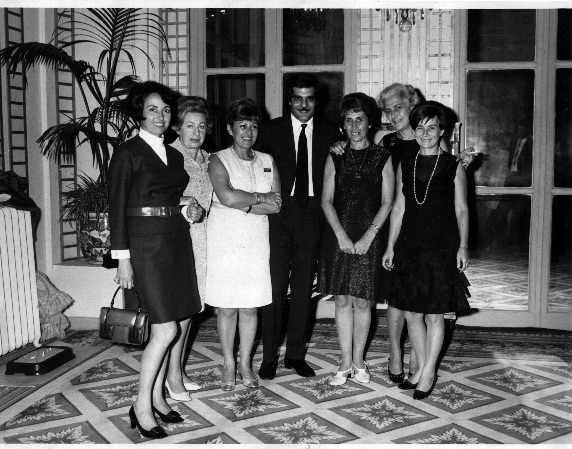
Freddy’s wife Rena and her twin sister Viki (Wilhelmine Sass) were both remarkable women. Rena became known in Viennese society for her bridge tournaments, while Viki was even more accomplished – she played for Israel in the Bridge Olympics and once met Omar Sharif. Viki had a tragic and complex life: she was first married to Friedrich (“Fritz”) Eduard Lokesch, who died in Auschwitz. Remarkably, she later worked as a physician in the Theresienstadt concentration camp. A letter from Viki and Fritz survives in an archive in the United States (https://holocaustcenter.jfcs.org/findingaids/19901022lokesch.html).
Legacy and Reflection
After Edy’s death, some pieces of costume jewellery were found that seemed uncharacteristic of Rena’s taste. Florian believes they kept them because they were relics of the family’s past – likely items made in the feather and jewellery workshop once run by Jonas, Rudolf or Edmund. These fragments of survival, memory and identity – jewellery, old documents and a saved life through a mysterious stroke of luck – help me feel connected to a family line that survived almost unimaginable persecution.
[1] 1 Lehmann’s Address Book (Lehmann’s Adressbuch) was a long-running and highly regarded 1 city directory for Vienna, roughly equivalent to a combined phone book, business directory, and “Who’s Who.” Public access available: https://www.digital.wienbibliothek.at/periodical/structure/5311
[2] Source: DIETER J. HECHT, MICHAELA RAGGAM-BLESCH: Der Weg in die Vernichtung begann miWen in der Stadt. Sammellager und Deporta1onen aus Wien 1941/42


 Greenwood family history
What an amazing piece of family history ! And I received it today, my mother’s birthday (Vienna, 1922). Thank you ever so much for all the research and effort put into this incredible puzzle of your grandmother’s (Sylvia) family history.
LikeLiked by 1 person