Started 01/01/2013
Chapter 4, Darwen 1938-1940
When we arrived in Darwen, we lived, to start with, in a hotel, the High Lawn Hotel on Blackburn Road, the main road from Darwen to Blackburn perhaps ¾ mile from the town centre. It was owned by a couple called Baines, who also owned a café, the Criterion in the Darwen town centre. I seem to remember that they were always very kind and friendly to me. When I was small and people asked me what was my earliest memory, I would say that I could remember standing up in my cot, looking out of the window and seeing some green railings; this may have been at the High Lawn.
Dad bought a new just-finished house straight away, a three bedroomed semi, in Earnsdale Avenue, as we said “Up Sunnyhurst”. It cost £ 555 and was one of ten (five pairs of semis), built by a local builder called Bob Shorrock. (Builders called Shorrock get mentioned in that book about Darwen F.C. in the 1870s, “Underdogs” that came out a few months ago). They were referred to as the castle houses because they had some turret-like bits over the third bedroom. These had a faulty design, and let water in when it rained, and they were removed, one by one, from all ten houses – at the owners’ expense of course. I don’t know how much money there was for a deposit for the house, nor how we got a mortgage, but we did. Then my mother’s parents arrived in spring 1939, and all our possessions arrived in a shipping container (always referred to as der Lift in German, a word not known to Leo.org) which lived at the end of our drive for maybe eight to ten years, after which it was converted into a garage.

Everything that we had, the furniture, clothes, kitchen utensils, everything, everything, the oven, the separate cooker (gas), the clinical thermometer in °C that went under your arm (in England it was in °F and went under your tongue), the coke-burning slow combustion stove – the one that I’d burnt my hands on in Vienna I suppose – and which was installed in my bedroom (das Kinderzimmer) was Austrian, and very visibly not English. As I gradually became aware that we were, that I was, different, you can imagine how badly I wanted to be like everybody else.
So here we were in Darwen, a rather poor, run-down mill town. A bit about Darwen; it was a long narrow town, about 29,000 inhabitants, following the valley of the River Darwen which ran south to north, Blackburn about five miles to the north, Bolton some nine miles to the south. The main road ran along the valley, and it was all uphill on either side. Sunnyhurst was to the west of the main road, uphill all the way. We were perhaps three quarters a mile from the main road. Darwen had grown from very small beginnings during the 19th century to become mainly a cotton spinning town. Quite a lot of the mills had already gone out of business and fallen into ruin before the war, following the slump after the crash in 1929. Unlike other mill towns, it was fortunate to have some other industries, a Crown wallpaper factory, Walpamur, who made paint (later renamed Crown Paints), a paint brush works, an I.C.I. Plastics factory which made Perspex, and some textile specialities, such as Carus who made medical dressings. It was built up to the north all the way to Blackburn, but surrounded by moors in the other directions. It was said that you could count over 50 mill chimneys from the town cricket ground, Birchhall.

What happened next? Lots of things of course. We had to learn English, for a start. There were books in the house for learning English, “Ein tausend Worte Englisch” is the only title I remember; it was in lots on magazine-thickness sections which all slid into a cardboard holder; there was also an English reader which I also read endlessly later, with the story of the heroic Grace Darling, and a true account of a couple who got lost in a snow storm in Grasmere and froze to death, (the husband had put his jacket round his wife),… I remember my mother reciting, “In winter I get up at night, …” by Robert Louis Stevenson, and “I always eat peas with honey, I’ve done it all my life, … ” by ??? There were immigrant howlers; my mother once wanted to buy some halibut at the fishmonger’s, and asked for hedgehog by mistake. There were immigrant jokes. A refugee asks the grocer, “Can I have some pepper please?” “White pepper or black pepper Madam?” “No, I vont toilet pepper.”
To get me going with learning English quickly, I was sent to school very, very young, perhaps at three, (No play groups in those days). The first school I was sent to was the local Church of England primary school, St Cuthbert’s. There was a Miss Hunt who taught there and who lived just across and down the road from us, and I used to walk down and back with her. Later, my mother told me that at the beginning I would sometimes come home in tears because I couldn’t speak to or understand the other children. One day, I shat in my trousers while at school and I was walked home howling by two big girls. I remember that we walked up a different way from normal, up Avondale Road, not Earnsdale Road (They were sort of parallel). I was handed over to my mother/grandmother(?) with the remark, “Tommy isn’t feeling very well today.” By the way, in Darwen, Avondale was pronounced with the first “a” as in “hat”. Some years later, when I was at Hollins Grove (primary) school, a new teacher pronounced it with the “Avon…” as in Stratford on Avon, a long “a”, and we couldn’t believe our ears. We were all absolutely flabbergasted; how could anyone speak in such a peculiar way?
Quite soon after, I was sent to a little private school, always referred to as, “Miss Reagan’s”. It was near Darwen town centre and it meant going and coming back by bus (the Sunnyhurst bus). The fare was 1/2d, and I remember handing my penny to the conductress regularly and saying, “Ha’penny change please.” It must have been around then that I would say, when asked how old I was, “Three and a half”, and which would make it early 1940. So by then there were conductresses on the buses because a lot of men had already been called up for the army.
Miss Reagan’s consisted of one classroom, and one class, taught by Miss Reagan. It was a big, light room with a shiny wooden floor and Miss Reagan managed to teach by going round the different age groups, from four to ten year olds, setting each group some work and moving on the the next group. It was mixed, boys and girls, private and so fee-paying, and I must say, I was very happy there. We had slates and drew or wrote on them in chalk. I must have been speaking English pretty well when I started. I have no memories at all of not being able to speak English; perhaps it was too traumatic. I can’t remember much about lessons, but I can remember singing, dances, playing games (such as The farmer wants a wife, Poor Jenny sits aweeping, … ), and air raid practices. At that time one went to school with a school bag and a gas mask, and one wore one’s gas mask as part of the air raid drill. I had an ordinary dark grey gas mask but one or two or three of the kids had Mickey Mouse gas masks in bright colours; what could have been more desirable than that?
On the subject of speaking English, there was a man who came to our house from time to time in those days to – I don’t know – but he had a white opaque disinfectant smelling liquid and he seemed to be disinfecting the drains. Anyway, once I was watching him and asking him what he was doing, then spoke to a parent or grandparent in German, and he was astonished that such a little kid could switch languages so effortlessly.
When I was coming up to five, my parents were advised by ? friends and neighbours that the best local primary school was Hollins Grove, so I was sent there, and I assume I started when I was five in September 1941.
But before that, I’ll say a bit about the house and Sunnyhurst, about my pre-school memories, and if possible, a bit about what sort of a child I was.
The house was, as I’ve said a three bedroomed semi, typically 1930s, pebble dashed, leaded window panes, bits of coloured stained glass in the upper windows, no thought of draught proofing, lots of dampness. The houses were unnumbered and my dad decided to call the house Sylvia after my mother. All the other houses had “traditional” names like Buona Vista, Ardenlea, Zermatt, Rokeby, and so on. There was a small square of a front garden, a lawn surrounded on all four sides by a border with flowers. There was a drive up one side of the house, the left side if you stood with your back to the road, I ought to copy it from Google Earth – I will but not now – at the end of the drive, just past the house, the container, always referred to as the container, till it was converted to become the garage. The drive was concrete with two covered manholes, and there was a low brick wall on the left separating us from the neighbour’s drive which was at a lower level as our house was further up the hill. At the back there was a slightly bigger bit of garden; more later. Both the doors to the house were on the side of the house opening onto the drive. Downstairs, there was an entrance hall, a sitting room and a dining room each with an open fireplace, a kitchen and a pantry which had the back door to the drive. To start with the bigger room, facing the front was used as the dining room and the smaller room facing the back garden, onto which it opened through a pair of French windows, was used as the sitting room. This room had a door leading to a, I want to say cubbyhole, a tiny under-the-stairs room. This had the gas meter; (the cooking was by gas and you had to pay for it with 1d coins, it always smelt a bit gassy by the way), the electric fuse box, plus a card table, etc. And when I was very naughty, I was put in there in the dark and left to scream for a while. I suppose you can call that 19th century child raising.
Later, after the war, the use of the two rooms was switched, so that the bigger room, at the front, became the sitting room. These two downstairs rooms each had a gas tap at the side of the fireplace so that you could attach a gas poker – that’s what it was called – by a hose – which you lit (the poker not the hose) and put in the fireplace with firewood and coal on top, to get a fire going. The stairs leading upstairs started in the entrance hall, twelve steps, then either one more step on the right to get into the nursery or one step on the left to do a U-turn to go along the landing. My parents’ bedroom was on the right, the bathroom straight ahead, then a right turn, with the loo on the left and my grandparents bedroom ahead. When I was, I don’t know – three perhaps, I had a recurrent dream that I started walking down the stairs with my hand on the bannister, then suddenly I was rolling down the stairs head over heels, and my father and grandfather were at the bottom, crouching with their knees apart and their hands in front of them, like two wicket keepers, waiting to catch me.
The nursery was used as the living room; it had the coke burning stove that was always lit in winter, or rather, when a fire was needed, (not all night though) and so it was the warmest room in the house. I can remember crying with cold in the morning, begging my grandmother to hurry up and get the fire going. I slept in my cot from Austria, much bigger that a conventional English cot; it was long enough for me till I was seven or eight, I would guess. It had a brass frame at each end, with vertical brass bars, and to get in and out there was a horizontal bar along the side which could be raised and lowered. The sides were coarse netting, light blue I think. Apart from my grandmother’s treadle sewing machine, (the make was Dürkopp; you can read about the company on Wikipedia), there was a set of nursery furniture which had previously belonged to the Geiringers. There was a child’s wardrobe, with pencil marks on the inside of one of the doors, with dates, showing Heinzi’s and Eva’s height; it also had a shelf above the doors for books. Then there was the Wickeltisch, a chest of drawers with a special oilcloth top and three raised sides, for nappy changing. After Jimmy and I didn’t need it any more, it was given to the Schosses, and later we got it back for you two. I expect you remember it. There was my toy cupboard and a little table with two children’s chairs, one with, the other without arms. The whole assembly seemed to me to be a set, all painted light blue and white. Otherwise, there were two or three adult size chairs and a couch. This is where my dad’s mother slept during the time when she lived with us, where Eva slept during that famous first postwar visit with Fritzi, when she was about 17 and I was 10, and where miscellaneous visitors slept at other times.
To start with, the nursery had black wallpaper from the ground to about adult waist height, with a Mickey Mouse frieze above it. This was so that I could draw on the walls with chalk.
It was in the Austrian way of things to avoid sleeping next to a cold wall, so whenever that was a bed against a wall, (mine, my grandmother’s, my grandfather’s, my grandparents had single beds in their tiny bedroom) some sort of hanging was fixed along the wall to keep out the cold. It was also the Austrian way of doing thing to air the bed linen, eiderdowns, etc. by hanging them out of the bedroom windows; another source of embarrassment.
Other pre-school memories: I can remember being taken for walks by neighbouring “big” girls, 12-year-olds I guess, in a push chair, and also by my grandfather on foot, often with one of the neighbouring Airedale dogs. There were two of these living very close to us, one, Ben, two houses down at the Elisons, and the other just across the road and three houses up, Paddy, at the Gornalls. (It was mostly Paddy who came with us; in those days, with little traffic, dogs were out and about in the streets quite a lot I think). Both were very well behaved and not at all aggressive. My affection for Airedales comes from these two chaps. We mostly went on walks in the nearby Sunnyhurst Woods, and there were notices there saying that dogs had to be kept on lead, so my grandfather used brown shoe laces as improvised leads, much to my relief. The woods were on a hillside, so many of the paths went up or down quite steeply. I remember often complaining on the uphill paths that I was tired, “Ich bin so müde.” We’d find a bench and sit down and in no time I’d be bored and want to go on, “Geh’ma schon” (= Gehen wir schon). This became an often repeated family joke.
My grandfather smoked cigarettes and having next to no money, rolled his own on one of those little gadgets with two small rollers and a belt going round them. I watch him hundreds of times rolling a cigarette. First he put in a Rizla cigarette paper, then he’d get some tobacco out of a tin he always carried; the tobacco was then carefully distributed along the paper, then he closed the rollers, licked along the gummed edge of the cigarette paper that was sticking out and continued rolling; finally the finished cigarette could be taken out. It was called, “Zigaretten stopfen” but the best I could manage was, “Etten oppen.” And much to everybody’s great disapproval, when times were hard, as was mostly the norm, grandfather would sometimes pick up cigarette ends in the street, split them open and salvage the bit of good tobacco and put it in his tin.
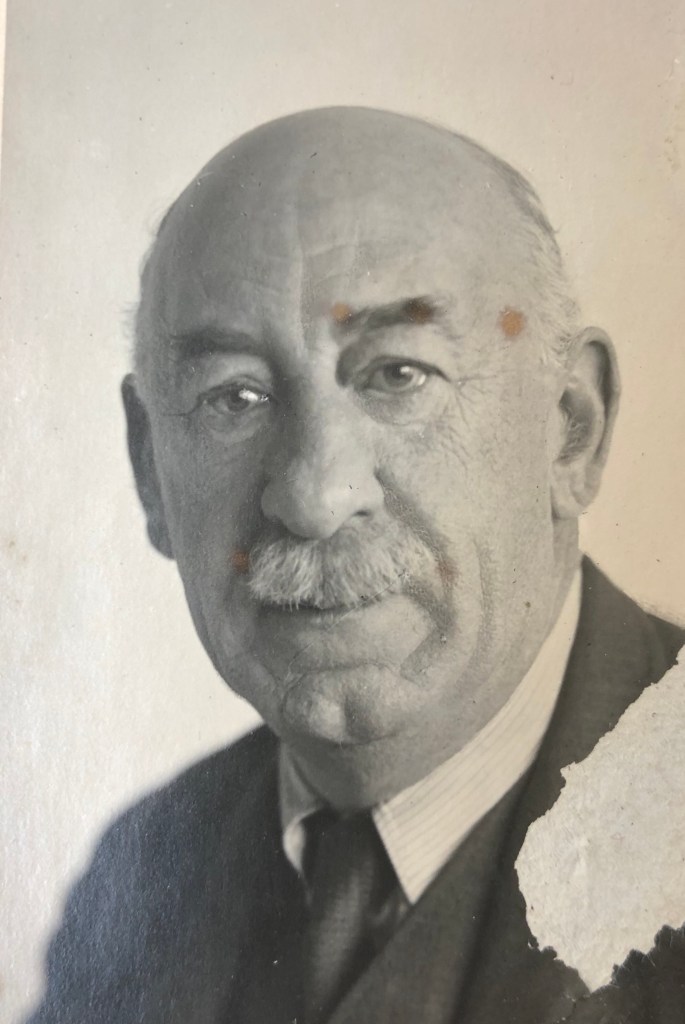
My dad was working full time of course, from the beginning, setting up and then running the Celco umbrella handle factory. It was called Britannia Mill and was part of an old cotton mill. The ICI Perspex factory was also in Britannia Mill, so it must, even in the late 1930s, have been broken up into units. If you Google “Britannia Mill, Darwen” you get a few hits including a street plan but no mention of my dad’s factory. He said that when he first went there, just after arriving in Darwen, so in late 1938 or early 1939, it was just an abandoned weaving shed with no roof and waist high weeds. At the very beginning, the first umbrella handles were made from cellulose acetate tubing; without going into details, these were all white and had to be painted. Dad was given a contact in Belgium, also a company that made cellulose acetate umbrella handles and they agreed to show my dad how to set up and run the painting operation. A woman came from Belgium and stayed with us for ?? some weeks ?? I can remember her being at our house. It must have been 1939 or early 1940, because Belgium was invaded on 10 May 1940 and then quickly overrun and occupied by the Germans. This woman was called Nellie Hergibot, a lovely person, with whom we stayed in touch. It was with the Hergibots that I spent a few weeks in the summer holidays in 1951; more later.
My mother must also have found a job pretty soon; as far back as I can remember, she was working as a clerk for a grocer called Jones’s Stores. They used to deliver groceries and I remember they had one ancient delivery van. It must have been an early 1930s model. Again quite early on, they were looking for a sales slogan to be painted on the sides of the van, and my mother proposed, “Let Jones’s Stores feed you,” and this was adopted. So for years and years I was very proud of seeing my Mum’s slogan on that bright yellow delivery van. Once my mother began to work at Jones’s Stores, we switched to them as our grocer. Previously we had gone to a grocer at the bottom of Earnsdale Road called Pickup. This was a small family grocer run by the parents (the father was called Harry I think) and their two grown up sons. They were always very kind to us and the father, Harry, used to speak very loudly. Perhaps that was just in the hope that my grandfather would understand English better if shouted at. My grandparents stayed with Pickup’s, at least for a while and I can also remember walking down to Pickup’s with my grandfather. I can remember once that he paid 6d (2½p) for seven pounds of potatoes.
I don’t have many pre-school memories of other kids. The only one I remember at Miss Reagan’s was a girl my age who lived just across the road from us called Sally Kenyon. She went to private schools all the way through the education system and in fact I saw very little of her; anyway, she was a girl and so she was of no interest at the time.
On the subject of health, I was a bit of a victim of my grandmother’s Austrian health wisdom. If ever I had a temperature, luckily not often, I was cooled down by being put to bed wrapped in a cold wet sheet. Very disagreeable. And at the least hint of constipation the orange rubber hose (the enema, die Spritze) was produced and pushed up my bum, accompanied by much screaming. Again, I’m happy to say it was rarely needed. Otherwise not a lot to say. I can remember having measles and whooping cough. I tended to think of myself at the time as being thin and weedy. Probably this was because of the endless pressure that I was under to eat everything on my plate and the terrible health and weediness consequences that would follow if I didn’t finish.
I developed a squint at a very early age and was wearing glasses to correct it as far back as I can remember. It was always said that I would have an operation to have it corrected when I was 10, as my mother had, but my squint was nothing like as bad as hers and so, no operation.
My childhood culture was of course all Austrian German to start with, and, especially because of the presence of my grandparents, it continued in England, language, nursery rhymes, popular songs, fairy stories, (Hauffs Märchen as well as Grimms’), Struwelpeter, Wilhelm Busch – not only Max und Moritz, folklore, music from a wind up gramophone with all sorts of 1930s records that my parents and grandparents had brought from Vienna…
My grandmother often sang :“Muss i’ denn”; she said that when she sang it to Heinzi when he was small, it made him cry. Here are the words I found through Google, a bit different from her’s; and she only sang the first verse.
| Muss i’ denn, muss i’ denn | Zum Städtele hinaus | Städtele hinaus | Und du mein Schatz bleibst hier
Wenn i’ komm, wenn i’ komm Wenn i’ wieder, wieder komm Wieder, wieder komm Kehr i’ ein mein Schatz bei dir Kann i’ auch nicht immer bei dir sein Hab’ i’ doch mei’ Freud’ an dir Wenn i’ komm, wenn i’ komm Wenn i’ wieder, wieder komm Wieder, wieder komm Kehr’ i’ ein mein Schatz bei dirWeine nicht, weine nicht Wenn i’ weiter wandern muss Weiter wandern muss Als wär’ alle Lieb’ vorbei Gibt es auch, gibt es auch Der Mädele so viel Mädele so viel | Lieber Schatz i’ bleib dir treu | Denk nicht gleich wenn i die andern seh’ | Wär’ meine Liebe vorbei | Gibt es auch, gibt es auch
Der Mädele so viel Mädele so viel Lieber Schatz i bleib dir treuÜber’s Jahr, über’s Jahr Sind die Träubele erst reif Träubele erst reif Stell i’ hier mich wieder ein Wenn i’ dann, wenn i’ dann Dein Schätzele noch bin Schätzele noch bin So soll die Hochzeit sein Und ein Jahr geht ja so schnell vorbei und bis dahin bin i’ dein Wenn i’ dann, wenn i’ dann Dein Schätzele noch bin Schätzele noch bin So soll die Hochzeit sein | ||||||||||||||||||||||
The rhyme for being bounced on an adult’s knee, mostly my grandfather was Hoppe, Hoppe, Reiter.
You can see and hear it on YouTube if you like (not my grandfather and me, I’m sorry to say).
So what else do I remember about pre-school German speaking times? The problem is starting to be that I remember such a lot, endless trivia, but what is worth recording? It needs to have some interest or significance, doesn’t it? And the memories blur; I can’t always say when things happened or what came before and what came after.

 Greenwood family history