I was commissioned to write this article for the Daily Telegraph after a trip to Amsterdam to trace my family roots. Unfortunately it was never published due to the pandemic…
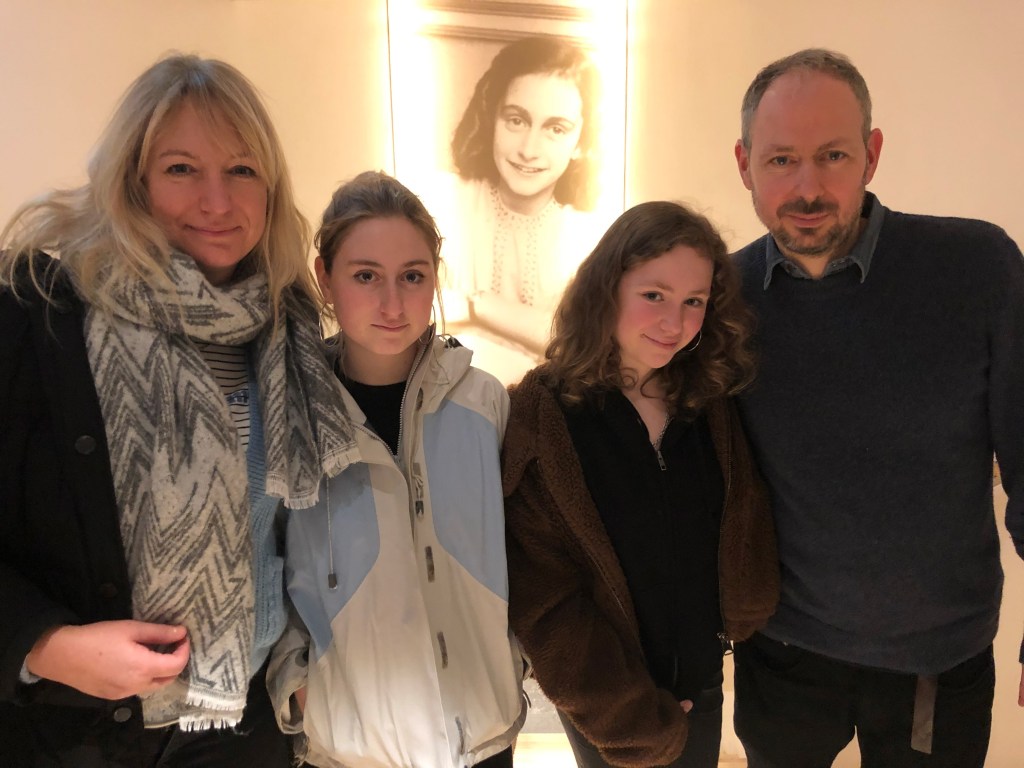
Jonathan Greenwood visits Amsterdam to explore his family’s time in hiding from the Nazis there and trace their connections with Anne Frank.
Amsterdam. It’s a good time city, a city of stag weekends, beer and coffee shops, where brightly coloured tulips and neon lights catch your eye as you take a free-wheeling bike trip alongside the canals.
I’d been on a boozy trip to Amsterdam in my 20s but this time – travelling with my wife and two daughters aged 12 and 14 – was going to be a more serious affair.
A few short decades ago the city was under Nazi occupation. Famously Anne Frank along with thousands of other Jews was forced into hiding, relying on the Dutch resistance to keep her and her family alive.
I’m planning to explore the parallels with my cousins, Eva and Heinz Geiringer, who as teenagers were also forced into hiding in Amsterdam with their parents. By a horrible tragedy but also through an incredible story of survival, the Frank family and my own became entwined. My grandmother’s sister married Otto Frank, Anne’s father, after the war.
The trip almost doesn’t happen at all. We arrive at Luton airport with storm clouds overhead and the wind picking up with the approach of storm Dennis. We’re on the last flight allowed to leave for Amsterdam that day.
We arrive with our nerves slightly shredded but relieved to have made it. We check in to our holiday apartment just outside the city centre. The weather is atrocious, with howling wind and rain. So Sunday is spent studying the incredible array of art in the Rijksmuseum – from Rembrandt, and Vermeer to Van Gogh.
But the next day we wake to blue skies and wrapping up we head off to the Anne Frank House.
It’s one thing to have read Anne Frank’s diary but quite another to spend some time in the cramped annex at 263 Prinsengracht. Steep wooden stairs take you up through spaces originally used as a warehouse and offices by Anne’s father, and finally up to the wooden bookcase built to conceal the hiding place behind. Walking through the narrow gap and appreciating the mortal dangers that threatened those in hiding is still chilling.
Despite the crowds of tourists, you can appreciate everyday life for Anne and her sister Margot, her parents and the four other people who hid there. The lack of privacy, the incessant boredom, and the constant fear of discovery. The rooms are now largely empty, but the newspaper clippings of film stars are still glued to the wall in the room where Anne slept. To me the saddest room is the attic itself, where Anne came to be alone and from where she could see just a corner of sky.
Part of the reason for the timing of the trip was that my eldest daughter Louisa is now 14 – the same age Anne Frank was when she was in hiding. I’m keen to hear her thoughts and feelings when we regroup at the end of the tour.
Louisa says coming to the house helps separate fact from fiction in her mind. “The story is so well known, it’s like Anne is just a character in a book. I think it can be hard to imagine that any of this really happened,” she says. But she adds “coming here really brings it home that it was real, that the Nazis actually existed, and all of it puts my problems into perspective.”
It also makes me think about my own relationship with my daughters. After the war Otto Frank was astonished by the depth of thought and seriousness of Anne’s diary: “most parents don’t really know their children” he said on first reading it.
In the museum café, we’re joined by Head of Collections Teresien da Silva and also by Gertjan Broek, who as a researcher and archivist is an expert in the Anne Frank story.
They hear our impressions and are also interested to find out more about my connection to the Frank family. The parallels are eerie.
My father’s first cousin Eva Schloss (nee Geiringer) was a teenager when her family fled Vienna with the rise of the Nazis. They came to Amsterdam, where they met the Frank family, living in the same area, the large Merwedeplein square in Amsterdam. Eva’s older brother Heinz, was at the same Jewish school as Anne’s sister Margot where they became close, often doing homework together. Eva and Anne were acquaintances if not friends. Eva describes how different she felt from Anne – Eva being a tomboy while Anne was much more fashion conscious and mature.
Margot and Heinz were both called up to report for deportation to ‘work camps’ within days of each other, which triggered both families to go into hiding.
Heinz, like Anne, was creative. Unable to play guitar and piano in hiding, he took to painting and writing. Both paintings and poems movingly reflect his despair and his deep longing to return to normality.
Clearly worried about discovery, Heinz hid his paintings and several notebooks full of poetry under the floorboards of his secret hiding place. The family were raided by the Gestapo on Eva’s 15th birthday, on the 11th May 1944. Heinz explained to her where his work could be found as they travelled together on the nightmarish three-day train journey to Auschwitz.
Eva and her mother miraculously survived the death camps, but Heinz and his father died, tragically just days before the end of the war. Finally, the paintings and poetry books were recovered where they’d been left, along with a note: “Property of Eric and Heinz Geiringer from Amsterdam who are in hiding and will collect the items after the war.”
Eva’s mother Elfriede went on to marry Otto Frank, and together they spent many years keeping the memory of Anne Frank alive, through the development of the Anne Frank house, and also writing many hundreds of letters to the young people from around the world who wrote asking questions about Anne.
Teresien scribbles notes as I explain the family history, how my father escaped to England aged two,, how my grandfather, an engineer, was able to find work running a factory in Darwen, Lancashire, and how the family were later told the Gestapo had called for them at their home in Vienna, just days after they left. They’d been warned to get out by a business acquaintance who’d joined the SS and visited in full uniform.
I’m then quizzed about my own personal memories of Otto Frank. To me as a small boy in the 1970s he was always just Uncle Otto. Despite his terrible experiences, and the tragic loss of his entire family he was charming, warm and kind, never bitter or angry. He was always happy to chat and entertain us.
Over coffee, we get to ask questions about the latest research on the betrayal of the Frank family. There’s a cold case team lead by a former FBI agent working on a number of theories with the findings due to be published next year. Some even think that the family’s discovery may have been accidental – following an investigation into the trading of black market coupons on the premises.
We leave the Anne Frank House and head to the Resistance Museum (Verzetsmuseum) across town. At the entrance, we’re greeted by a life-size cutout image of Eva as a child. Her story is featured as one of four young people in the children’s section of the museum, whose lives were affected by the Nazi invasion of the Netherlands. Through audio visuals in the exhibition, we hear Eva’s story in her own words. And there on display are Heinz’s paintings.
The rest of the trip is more upbeat. We hire bikes (thoroughly recommended) visit the brilliant Van Goch museum, and explore the canals on one of the many boat trips on offer. We head to the airport feeling exhausted but inspired.
On the plane back to London I can’t help thinking about the huge contrast between the freedom and beauty that are so central to Dutch culture with the exclusion, loneliness and cruelty experienced by Anne and by Heinz.
Eva has written several books about her experiences. Now Heinz’s poems and paintings have, at last, been turned into a book, published to mark Eva’s 90th birthday.
His last poem before his betrayal and deportation to Auschwitz reflects the thoughts of an introverted young man who has spent many hours in isolation:
“In the end, nothing can ever emerge so purely/Nothing can be as simple and yet as beautiful/As what is born of your inner self/What is destined for you and you alone/What blows your way like a soft breeze…”

 Greenwood family history