Chapter 12c Toys and games
I’m making the sections a bit shorter because I don’t want to send you lots that you’ve already read every time I send you a new bit.
Toys more or less disappeared during the war. There was one toy shop in Darwen, Henry Walley’s, on the main road, about two blocks along from Jones’s Stores, towards Blackburn. Kids who had pre-war toys were greatly envied. Henry Walley’s was full of stuff when you went, he did manage to keep going, but there was very little made of metal. Stuff like jigsaw puzzles (cardboard), board games, clay marbles that nobody wanted… He had some odd bits of Meccano, not much use.
From Vienna or before the war, I had three soft toys, a large white teddy bear called Teddy, Der Teddy, pronounced Tädi, in German, and also a dog and a cat, about life size. The dog was light brown, a sort of terrier, full of straw, it seems, and very stiff. The cat was softer, even silky, greyish white, I think. Once I gave it a trim with my grandmother’s dress-making scissors (perhaps???), but then it was done for. Its fur never grew again. Only Teddy had a name, Teddy. He also had a bad end. Once Michael Fish and I decided to torture Teddy, I don’t remember how but we were witches – though not female of course, perhaps we didn’t know that male witches were called wizards; it would have been gruesome, no doubt. When he was finally dead, we threw him out of the Kinderzimmer window and his head came off when he hit the ground. The girl from across the road, Sally Kenyon, about my age, four or five at the time, very kindly stitched the head back on, but it was never the same again. You couldn’t rotate it any more for a start. And who told Sally that Teddy’s head had come off? A mystery.
Also from Austria, there was the Anker Steinbaukasten, a stone building set; but I think I’ve already described that. If I did, I can’t find where, so if I’m repeating myself, I apologise. It had a very handsome wooden box with a sliding lid, and the pieces were inside. They were stone or maybe some sort of imitation stone, anyway stone-like.
It was very similar to this picture from Google images, and pieces were stone colour or brick or slate colour. The lower slate coloured piece in the photograph is the church spire by the way. There’s plenty more to see on Google Images. Actually, mine had quite a lot more pieces, at least twice as many, than the one in the photo. And it was quite heavy.
That’s all I can remember as coming from Vienna in the way of toys (there were some children’s books, Der Hund und die Katze, Himmel meine Schuhe, …). There was also, of course the Austrian game, Trust, which was very similar to Monopoly, and which I played for hours and hours and hours with my friends, especially Michael Fish and Tony Collins.
I also had lots of coloured wooden building blocks, two sets, one plain cubes in different colours and the other similar but with letters of the alphabet on two ends. I must say, I spent hours and hours building with them. Another thing I had when I was still very small was a toy red train, all wooden, and very simple, an engine, a coal tender (perhaps) and two carriages. It was given to me by a friend of my parents, referred to as Uncle Dick. I can barely remember him, but my mother told me later that he died of cancer very young. In fact it was through that, that I first learned of the existence of cancer. I remember how my mother explained to me that it was a terrible illness that very often could not be cured, so that people died of it.
Another very exciting event when I was very small was the arrival at our house one day of an L.M.S. (i.e. railway) delivery van, quite a big one, with a big parcel for me. It turned out to contain a rocking horse, actually a small and I guess cheap one, red metal tubing rockers, a light blue padded seat, and a horse’s head (flat, just a silhouette) with handles on either side to hold on with. Anyway, I was delighted, though after the novelty wore off, I did not do a lot of rocking I suppose. For some years after I imagined that railway vans were always full of toys.
Round about that time, I was also given a tricycle (I just looked out a photo of it, with me on it, dated 1941, but I’m not going to scan it and copy it just now). It was the only bike/trike I had until I was given a full size bike for Christmas in 1951 (after I’d learnt to ride a bike in Belgium the previous summer). It was a nice trike and I was very pleased with it to start with, but very quickly my friends pointed out that it had solid tyres whereas superior trikes had pneumatic tyres, so then I was a bit less pleased. Also in no time, all my friends had two-wheelers, – often small ones called fairy cycles – and when they went off, I could not keep up. I must have grown out of the tricycle within a year or two, and my parents would never buy me a bike. They said Darwen was too hilly, but I think they were afraid that I would have an accident.

I’ve already mentioned the Meccano sets that Dad sent/brought me from France, and how the French Meccano factory kept going during the war while the British one didn’t. (I just read on Wikipedia that Meccano is now made only in France).
I had quite a few jig-saw puzzles, which I put together and then put away many times, and some other board games besides the Trust. We played lots of games of Ludo, Snakes and ladders and draughts, in particular. At some point I was also given a chess set, with pieces (black and white) made out of china. My grandfather taught me how to play, and by the time I was ten, I could sometimes win. When I played against Dad I always lost.
I guess there were other toys; I had a toy cupboard which was always full.
What I played with most, from the age of about eight till ten, was the toy farm I had. At some point a “farm set” arrived, including a board which was the farmyard, and two or three outbuildings (not fixed), all made of wood, plus some animals, cows, sheep, pigs, etc., made of lead. One of the things you could get at Henry Walley’s was lead farm animals. But not lead soldiers, which I now find surprising. Anyway, I gradually acquired a big herd of cows, mostly black and white, but also, I remember some pinkish ones that had their ribs showing, given to me by Brian Holt, and a bull and some calves. Also a good size flock of sheep, lots more pigs, some pink, some black,, chickens, geese, turkeys, a tractor, some machinery – some horses – and carts; in fact, most of it is still in our cellar here in Ste Foy. I could never bear to throw it out or give it away – or give it to Jimmy. Those lead toys were extremely brittle. I always put everything out on my bedroom floor. Once my grandfather stepped on a cow and one of its legs broke off. Did I yell and cry?! Playing consisted basically of going through the routine of the farm from morning till evening; bringing in the cows to be milked, then sending them back to the field again. There would be dramas as well, but I don’t remember any of that, just the milking, the hay-making, etc, as it happened on Bland’s farm.
It’s also worth telling you that I must have played on my own a lot. With the farm; I played with Michael Fish or Brian Holt occasionally, but I spent hours and hours playing alone. Ditto doing jig-saw puzzles, playing with my Meccano… I made all sorts of things out of Meccano, cars, lorries… the snag was that I never had a motor for it. Later you could but clockwork motors, but I never had one. What I made the most was cranes, which I then used for lifting all sorts of things.
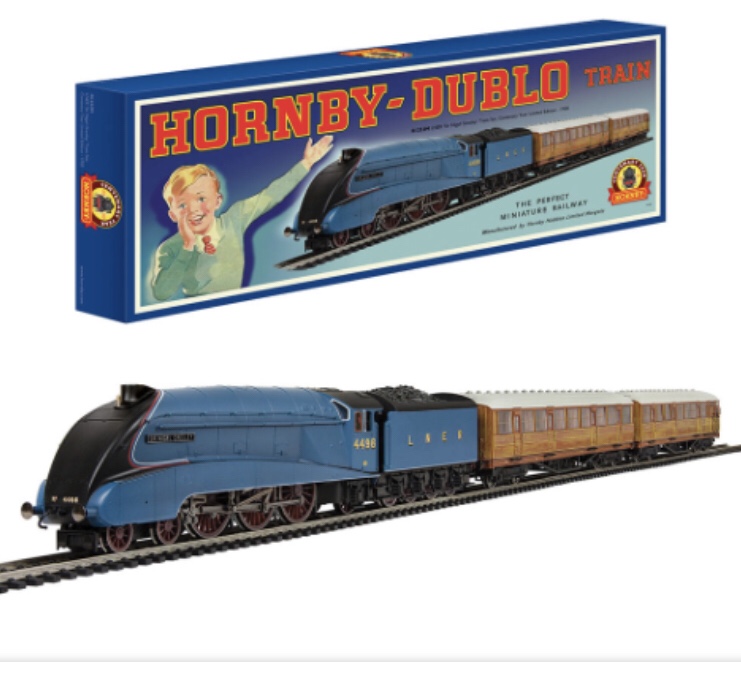
The last thing that one could call a toy and that I played with a lot was my electric train. I was given the basic set for Christmas I think in maybe 1947 or 48, when I was 11 or 12. The basic set I was given – a Hornby Dublo (Dublo because the gauge was double O or OO, actually 00) – was the LNER set, an engine, the Sir Nigel Gresley (who was an engineer who worked for the LNER; he must have done something exceptionally good I suppose), the coal tender, two passenger coaches and an oval of rails, plus the transformer/control box (as shown below). We were still in the time of shortages, and only producer of electric trains was Hornby. (the Meccano company made Meccano construction sets, , Hornby trains and Dinky cars and trucks, all made in Binns Road, Liverpool, by the same company – read as much about it as interests you on Wikipedia) – and at that time there were just three train sets available, the LNER set that I was given, the LMS set, also a passenger train and two coaches; the engine was the Duchess of Atholl, and a GWR set, a tank engine and some (not many) goods wagons.
Here are a couple of pics from Google images. There are a whole lot more. At that time the Meccano company was the only one making decent electric trains, etc, etc, in the UK. Everything else was dreadful.
My best friend at Lancaster RGS, John Meeks, had a German – I guess pre-war – Trix Twin, also OO train set, called twin because you could control two engines independently, which you could not do with Hornby till much later (so far as I know). John’s set was in the attic of their house in Silverdale, so could be left out for weeks on end. It was the electric train set that I could only dream of, several engines, lots of rolling stock, lots and lots of track with points, signals, stations, lots of other buildings, tunnels and bridges… and it was mounted on a huge board that could be folded in two and stowed away when not in use. John’s dad was a highly competent practical man, an electrical engineer, and he must have really enjoyed making all of that for John.
I could only play with my train set on my bedroom, which meant always, or nearly always, having to take everything apart in the evening and putting it all away. I gradually also acquired lots of additional track, points, signals, railway stations, and played with it mostly on my own or with Roger Walkden, whose family moved to Earnsdale Avenue from Clayton-le Moors near Clitheroe in 1948/9. I think he also had Hornby Dublo stuff so we sometimes put it all together. We never had all the automatic things you could have later, automated points, signals, etc. We certainly played a lot though, and it seems we mainly played at running the railway company to a timetable that we made up. I don’t think we often played at disasters or robberies. In fact, didn’t I keep that train set? Did Jimmy play with it later? Did you Johnny?
I guess I played with it for maybe three years, till I was fifteen.
And before I forget, we were also crazy about Dinky cars. My first one ever looked like this, a London taxi; in fact, it was this, the same green and everything. When the first Dinky cars began to appear at Henry Walley’s toy shop – the only place where they were sold in Darwen, starting a year or two after the war – when he received a delivery, it was always sold out within hours, and you just took what you could get. And that’s how I got the London taxi. They were not cheap, a week’s pocket money would buy one cheaper one. We played with them, among other things, on the pavement opposite our house – on our side of the road, the pavement was not made up, but was just soil and stones and weeds. So we would let them roll down the hill, and then race them down the hill, and in no time, mine, and all the others were looking pretty bashed up.
Keith Eckersley, my best pal – and the person I was running after when I collided with a car, as described above somewhere – till the family left for Winchester I think around 1945, had the most fabulous, but really fabulous, fleet of pre-war double decker Dinky buses. They were too precious to play with, but every now and then they were taken out and looked at reverently.
A year of two later, as supplies improved, I collected the set of American cars, a Lincoln Zephyr, an Oldmobile, a Buick, a Chrysler, a Studebaker and a Packard. There were six to a set at the time, but you bought them one at a time in you were normal. And by the time I lost interest when I was fourteen or fifteen, I had quite a collection, which Jimmy inherited.
It’s strange, I feel, that I remember all my toys and games so well, but remember playing with them and just how we played, so much less.
Did I mention that one of the friends of my dad’s from Vienna who was also in London in May 1938 was Micki Weiner. The household was more or less like ours, the parents, Micki and Grete, her parents who were Hungarian speakers, I forget their names, and their son, also Tommy, about my age and a girl a bit younger. Micki Weiner was very successful in textiles, wool, and when I went to their house with my parents soon after the war, the lived in a huge house, called “The White House” in Golders Green. He had a Rolls Royce and a Cord, a sporty American car of that period, and Grete had a Packard just like this one pictured. Hence the comment about the Weiners at this moment.
I’ll stop at that for now; there’s more to say about toys and games, but I want to move on the other things now. Just one final remark; also said elsewhere I think. I was the only kid up Sunnyhurst who had other kids in his home to play. Not one other family had neighbouring kids playing in their house. I went to the Jepsons and the Hulls for birthday and Christmas parties, but otherwise never. And never stepped into any other kid’s house. Another point, and it was a problem for me, was that none of the kids around us were my age. They were either a year or two or more older or younger. And I played mostly with Michael Fish and Brian Holt (often with just Michael, almost never with just Brian), who were both two years older than me, or with Tony Collins who was a year older than me; which meant that I was always the junior partner, as it were. So there was no development of my leadership qualities.

 Greenwood family history