Tom memories, Chapter 12a, Darwen up till 1947, reading, holidays
(started 2 Aug 2014)
So we’re still stuck in “Darwen up till 1947”. I’ll start with books and reading. So…
Books and reading
I was a good reader and, I think, an early reader. When I was in Class 1 at Hollins Grove, I remember that Miss Hargreaves once had me reading out loud to a visitor who I now suppose was a school inspector. In which case she was showing me off as one of her successes.
There were not many books in the house, nothing in English for quite a long time, until my grandmother and mother got going with reading library books from Darwen public library. By the 1950s they were both big readers of library books, I would say exclusively of novels. Otherwise, at home there were a few books in German, a set of “classics”, I guess mainly 19th century, that belonged to my grandfather and nobody looked at. These were at Highcrest till my dad died and then I gave them to Caroline. I’ve already mentioned the books in the house somewhere, a few books for learning English, two or three books, mainly poetry, by a relative, on my grandmother’s side I think, whose pen name was Safir, a few novels, that’s it.
I was not adventurous or courageous with my reading, and I often felt daunted when confronted with a new book. There were favourites that I re-read several times; when I was very young, ( and not so very young), Dennis the Donkey, (a donkey that won first prize in a balloon race), Puffer, Muffer and Pip-pip, (Daddy, Mummy and baby railway engines), the Rupert Bear Annual, every year from about 1940, later a funny book called The Noddles – a set of short stories about a family, the parents and seven children, three pairs of twins plus one (given to me as a birthday present by Geoffrey Outhwaite), The Story of Doctor Doolittle, Doctor Doolittle on the Moon, Doctor Doolittle’s Circus. In fact the books I owned were all without exception, it seems, birthday or Christmas presents. There were several other Dr Doolittle books which I never read, but I read and re-read the ones I had. By the time I was eight or nine, I’d read a whole lot of William books; I owned William the Fourth; – It was given to me in quite a battered condition by someone who didn’t want it any more; all the rest were borrowed from William Reeves.
It was a similar story with the Arthur Ransome books. I read and re-read the ones I’d been given, Swallows and Amazons, Coot Club, one other. By 1945-6 I was also reading Biggles books, and that was the only time that my dad and I read the same books and were enthusiastic about them, and actually talked to each other about them.
The Rupert Books were very important for me, and were also read and re-read. The very first one was still pre-war hardback quality; all the rest were war-time economy quality, still hard- back but thinner and – in fact not all that different otherwise, as I remember; the pre-war ones just had some puzzles and games at the front and the back, while the wartime ones didn’t. During the war, they were always in short supply and had to be ordered – for Christmas – well in advance. There was one disastrous year when my mother couldn’t get one, and, well, what a major calamity that was for me! Incidentally, all books during the war had a phrase about being war-time economy editions somewhere at the front. The Rupert books had four colour pictures per page, and the story was told twice, once as a rhyming couplet under each picture and again as prose in two columns at the bottom of each page. The very first story in my very first Rupert book was called Rupert and the Red Egg. Rupert finds a big bright red egg (ostrich egg size) while out playing and brings it home. The next couplet, spoken by his mother, Mrs Bear, read, (I seem to remember),
“An egg so big, I do declare,
We’ll scramble, then we all can share.”
But before she got any further, the egg cracked open, and hatched out a baby dragon, which fortunately turned out to be friendly.
Some kids still had earlier (so, pre-war) Rupert books, handed down by older brothers or sisters I suppose, which had the pictures not in colour but in different shades of red. But still very, very exotic and desirable. There was a permanently running Rupert story feature in the Daily Express at the time; for all I know, there still is today! When I decided that I wanted to start collecting postage stamps, my dad quoted a Rupert story at me, when Rupert wanted to collect something, perhaps also stamps, and his dad said that when he had collected 50 stamps or whatever, he would get an album, and I had to do the same. Which I did.
We were encouraged to take books from the class library in several classes at Hollins Grove, but it seemed to me that they were mainly girl’s books, Little Women, What Katy did, and so on, and that reading was for girls.
I read Alice in Wonderland a few times, but I did not come across Through the Looking Glass till much later; and I really liked and re- and re-read The Water Babies by Charles Kingsley. I remember such a lot of the details. (Perhaps I should buy it for your kids.) I also had a few books I just could not bring myself to start, Kidnapped by R L Stevenson for example. I was given Masterman Ready by Captain Marriot once – for a birthday or Christmas, and I finally started it, and then devoured it, much later.
Another book I loved and read and re-read was Stubbington Manor (given to me for my birthday or Christmas by Sam Duckworth. It was about a bear who inherited a manor house and went to live there with his friends – all bears, still keeping the human servants. The bears all changed their names to sound grand when they moved in. Golden Syrup called himself Mr. G. S. Y. Rup and Velvet Trousers called himself Mr. V. T. Rousers. That made me laugh a lot. The frontispiece was a picture of the bears just arriving; the door opened by a very grand looking butler looking down at a teddy-bear sized group of bears, with the caption, “’Crumbs’, muttered the dumbfounded butler.”
And I liked the stories in the Pooh books. And did I already mention Raggedy Pup, Tony and the King of the Crossword Isles? In fact, when I start thinking I remember more and more. Tarzan of the Apes, by Edgar Rice Burroughs: very important, because this was the real Tarzan, not the Hollywood Tarzan who was much less authentic. And then there was The Gay Dolphin Adventure by Malcolm Saville, which I enjoyed a lot. Enid Blyton was going strong at the time and was much appreciated.
Then there were comics, which was definitely reading of a sort. When I was 5, 6 and 7 it was the Dandy, brought home from work by my mother once a week, and when I was 8, 9 and 10 it was the Wizard, a “story comic”. In the 1940s there were the two very popular picture comics, the Dandy (with Korky the Cat, Desperate Dan and Our Gang…), and the Beano, (with Big Eggo, an ostrich, Lord Snooty and his Pals…). Then there were the four “story comics”, the Wizard, the Adventure, the Rover and the Hotspur.
I liked those comics very much, re-read them often, never threw one away and thus accumulated a huge pile; till my mother (I assume) threw them all out. The Dandy and the Beano (which I also got to read quite often) were not really funny, each item just described an episode, and they all, one way or another, played on a recurring theme; Hungry Horace was always hungry and greedy; Keyhole Kate was always nosey; there was a lot of right and wrong implied, and right always triumphed. As well as the strip comic format, there were also two “serious” stories, over two pages,with a paragraph of text under each picture. The first one of these to come to mind was Black Bob, a super intelligent collie which worked as a sheepdog, in Scotland. There was also Smith of the Lower Third, about Smith and his pals at a, I guess, pretty posh boarding school.
No doubt the vocabulary in those comics was limited and the stories naïve, but I certainly read lots.
Even more so with the story comics, as we called them. I only got the Wizard, but I usually had a good idea what was going on in the other three. There was “The Truth…”, and later “The Further Truth…” “…about Wilson”. Wilson was a brilliant athlete who would turn up at athletics meetings unannounced, would win an event in world record time and then would disappear again. Eventually it turned out that he was several hundred years old and had somehow acquired a means of eternally living (perhaps) a super excellent life. There were other comics which I/my circle regarded as less cool, and which I just read occasionally. The Knockout, Film Fun and Radio Fun, and others.
You could argue that I could have spent all the time I did reading comics reading something most profitable, but kids should also spend time having simple undemanding pleasures I would say. The killer blow came when I arrived in Lancaster RGS as a boarder in September 1947, and we were told that all comics were banned, and being caught in possession of a comic was an offence. Except that in 1949 or thereabouts the Eagle appeared, a comic which not only entertained, but also educated and informed. So everything changed and we were allowed to read the Eagle.
And then, there were the stories that were read to me. Bedtime stories were always very important when I was small. It was only my mother who ever read to me; except when Tante Dorle (diminutive of Dorothea) was staying with us – the widow of my grandmother’s brother Ernst – and she read some stories to me in German. The only thing that I remember was that in one story a child was begging to go to the beach, “Ich will an den Strand”. Dorle made it sound so plaintive that it was a family joke for years. Just of wanting something desperately badly.
Also in German, my mother read me a book called, “Himmel meine Schuhe”, about a man who had a lot of money with him and was afraid of being robbed, so he hid the money under the inner soles of his shoes – highly improbable – and then he put them outside the room of the hotel where he was staying in the evening to be cleaned – even more highly improbable – , and then in the morning the wrong pair of shoes had been returned to him. He managed to find out who had his shoes, but this person had already checked out and caught a train. Then there was a long car chase to catch up with the train. I remember laughing and laughing at that story.
As one writes, I’ll repeating myself, one remembers more and more. Of course there were the Strubelpeter stories, big chunks remembered off by heart, and Max and Moritz, and all the other terrible stories in the Wilhelm Busch album (a big old red book, printed in Gothic lettering, as were many of the others, and said to have belonged to my dad as a child). Also there was “Emil und die Detektive” another big favourite. And all those fairy stories, often so cruel, in Hauffsmärchen.
So to sum up, a pretty unremarkable reading history for a brightish primary school boy. I certainly didn’t read “every book that I could lay my hands on”, like some bright young people from non-intellectual homes. I did once ask if I could take adult books out of Darwen library when I still just had Junior Member tickets. The library assistant asked me what I had in mind and I mentioned one or two authors whose books I’d seen around, perhaps library books at home. This is all very vague, but I’m sure I did mention Agatha Christie. And the assistant said that she thought I was still too young for that.
And so, on to…
Holidays.
Holidays up to 1947:
1942: Blackpool
1943: Southport
1944 and 1945: St Annes-on-Sea
1946: Llandudno
1947: Not sure, possibly Stair, a village near Derwentwater. Actually not; Jimmy was born in April 1947, so perhaps we did not go on holiday that year. I never thought about that before. Stair must have been 1948.
Who went? Always my mum and me, and sometimes my dad. I would say that he came for sure in 1942 and 1943, not to St. Annes in 1944 and 1945, for sure again to Llandudno in 1946. Holidays were always for one week in those days; longer holidays were unheard of. I think we always went during the Darwen holiday week, (I never heard anyone talk about “wakes week” at the time). Each Lancashire mill town had its holiday week when all the factories shut and most people who could afford it went on holiday. The Darwen week was early, perhaps the second week of July. (I just checked via Google; the Darwen holiday week began in the second Saturday in July, so at the earliest on 8 July.) So my dad must have organised some leave from the Czech army for the holiday week in 1942 and 1943, and by summer 1946 he’d have been demobbed. No doubt my mum was obliged to take her holiday during that week.
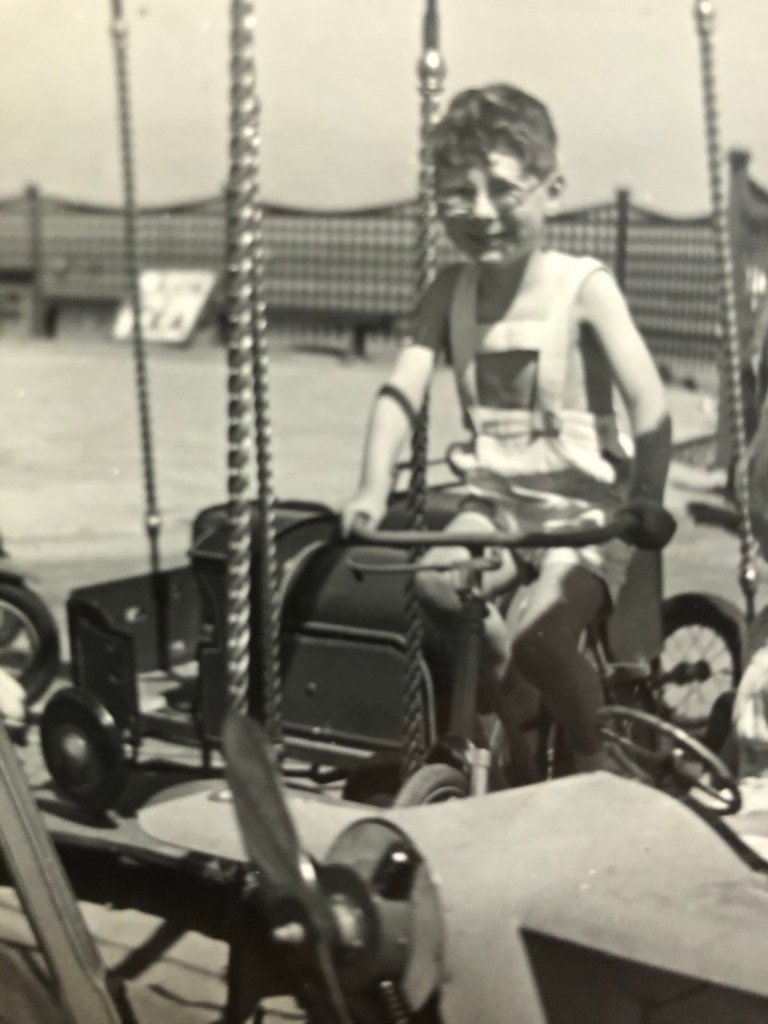
I’ve plenty of non-specific memories of beaches, buckets and spades, amusement arcades with slot machines (penny machines) where you always lost in the end, amusement parks, donkey rides…
More specifically:
Blackpool. I’d have been five at the time, two months off my sixth birthday. We went by train; in fact we went by train on all these holidays. And I think we started off from Darwen station, changed trains in Blackburn and changed again in Preston. And then on to the hotel by taxi, a black and white Blackpool taxi. And my mother made us sandwiches to eat on the train. The local trains had no corridors at that time and so no chance for going to the loo. Though I don’t remember that as a problem. And in passing, I think we went from our house to and from Darwen station by taxi as well; we were so loaded down with all our luggage of course. There was only one taxi company in Darwen at the time, I think, owned by Harry Harwood who also lived in Earnsdale Avenue. And all the taxis (all? certainly quite a few) were ancient Rolls Royces with extremely silent engines.
And we stayed at the Arandora Star Hotel. It still exists, I just Googled it. The Arandora Star was a passenger liner, owned by the Blue Star shipping line. For all I know, the Blue Star line also owned the hotel. I’m pretty sure there was a blue star on the hotel sign. I also just read that the ship was built in 1929, was requisitioned as a troop ship at the beginning of the war and was sunk off Ireland with the loss of some 800 lives in 1940.
I remember going on the Little Dipper at the Blackpool Pleasure Beach; I was too scared to ask to go on the Big Dipper. My dad took me on the bumping cars, and during one bump, my nose banged against the inside front of the seating compartment and I had an impressive nose bleed. I remember my dad carrying me away with my head held back.
Everything was new for me that holiday; it was the first time that I’d seen the sea and the huge sandy beach – though not the first time I played in the sand because I had a sand pit at home; the first time I’d been taken to a zoo, the Blackpool Tower Zoo. You don’t easily forget seeing your first lion and your first tiger. And it was the first time I’d stayed in a hotel; those breakfasts… the first time I saw (can’t be bothered to write “I’d seen”) toast in a toast rack… and a butter dish with the pats of butter made curled up into striped cylinders. And a dish with marmalade … and all the rest. And those green and white Blackpool trams, so new and modern looking, speeding along the promenade. So different from those slow old Darwen and Blackburn trams (except for the Queen Mary and the Queen Anne – the two new Darwen trams in case you’ve forgotten). And Blackpool rock, but it had to be part of your sweet ration, and so, even more desirable. And the three piers… I don’t remember much rain so the weather must have been mainly dry.
And here’s a thought, dear Caroline, dear Johnny: the more I write, the more you’re going to have to write when your turn comes to write down your memories for your grandchildren! Perhaps you’d better start now. And I sincerely hope that you’ve got your mother writing down her memories too.
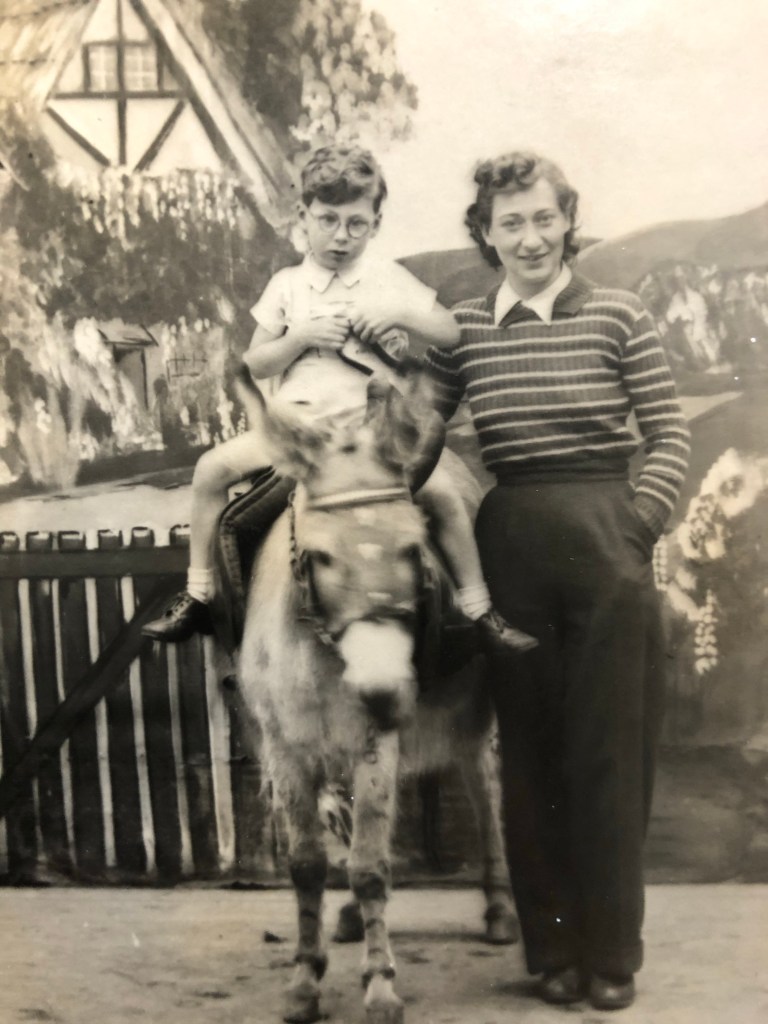
And Blackpool was the place where I had my first donkey ride. That’s a non-specific memory. But I do remember very well going to a photo studio and having my photograph taking sitting on a (real) donkey with my mother standing next to me wearing a jersey with horizontal navy blue, red and white stripes and navy slacks (that’s what women’s trousers were called at the time). That photograph is still in the childhood photograph album of photographs of me that my mother made up. She labelled it “Three donkeys”. Which makes me have doubts as to whether or not my dad came on that Blackpool holiday. But he was in the bumping car with me when I had the nose-bleed. Or perhaps that happened the following year in Southport. Memories get misty; you can’t bet on everything. Or even anything.
The lasting memory of Blackpool was that one afternoon after we came back from the beach, I was on my own in the room (why?), and I decided to wash my bucket and spade – a metal bucket and a metal and wooden spade of course, nothing plastic in those days) and I put the plug in the wash basin in our room, turned on the cold tap but when the time came, couldn’t turn it off again. So that the basin overflowed and water was pouring onto the floor, and I seem to remember that I was screaming. And then my mother re-appeared and turned off the tap and let out the basin, but not before the carpet was soaked and, as I later found out, water was coming (pouring? dripping?) through the ceiling of the room below. I can still picture all that in my mind very clearly. But it seems that no permanent damage was done, nothing serious anyway. And no one was angry with me, much to my relief, and as we were leaving at the end of the week, the hotel owner/landlady said good-bye to us very kindly and told me that I was a good boy and that I was forgiven for the flood I caused.
Southport
Not a lot of specific memories. A general memory of hotel, beach, sands, pretty good weather, a boating lake, a good holiday… Nothing outstandingly good or bad happened. A general feeling of a quieter, smaller, simpler resort than Blackpool. The only specific thing I remember is that we met some neighbours from Darwen, who lived just down the road, round the corner in Earnsdale Avenue, a couple called Ripley, with a daughter called Eileen, who was about my age. I knew of her existence but I’d never spoken to her. Anyway, we seen to have played together quite happily – there’s a photo of us in the album I mentioned above.
St. Annes
Again, I’ve very little in the way of specific memories. I was definitely there with just my mother. I can’t even separate the two years, it seems all blurred into one. We stayed in different hotels/boarding houses the two years, but I can’t really remember them. All seems to have gone well. I remember walking to and from the beach along quiet streets with little traffic, and garden walls with big pebbles set into them. The only specific memory is of VJ (Victory over Japan) Day. That was 6 August 1945, so we must have been there that week and not during the Darwen holiday week. There had also been mention in the news earlier in the week of the atomic bombs being dropped on Hiroshima and Nagasaki, and I heard talk of how it was good that the atomic bombs had shortened the war, because a land invasion of Japan could have gone on for a long time and cost more lives. (I seem to remember). There were a lot of fireworks being let off in the evening of the 6th and I can remember wondering where they all came from because fireworks were almost unobtainable at the time. The end of the war was announced very early in the morning of 6 Aug. and they had rung the church bells in celebration. My mother later heard a story that a woman had come out into the street when she heard the church bells and had asked if the church was on fire; when told, “No, the war is over,” she answered “Oh, is that all?”
I also remember that the Lytham-St Annes corporation buses, all double deckers, were a darkish blue, had Bristol engines and had “gearless bus” written on them. Someone told me that this meant that they had automatic gear boxes. So there you are; boys remember wars and buses best.
And, come to think of it, ice creams; there were some memorable ice creams. The most memorable, which I never got, was a “Knickerbocker Glory” the most expensive item on many ice cream and desert menus, always unattainable.
Llandudno
So it’s 1946, I’m nine going on ten, my dad’s home from the war and this year it’s Llandudno.
The first enduring memory is changing trains in Chester and for the first time, seeing G.W.R. railway engines. (G.W.R. stands for Great Western Railway.) In Darwen and the north west of England all the railway engines and trains were L.M.S. (London, Midland and Scottish Railway). When my mum and I went to see my dad in Galashiels in 1943 or 4, we changed trains in Hellifield and must have seen some L.N.E.R. (London and North Eastern Railway) engines.
We liked Llandudno, again lots of good uneventful days, a super beach, no memories of bad weather (for that, I have to think about a day trip to the seaside during or just after the war, can’t remember which resort, when we went by coach, by char-à-banc as we said in those days, pronounced sha-ra-bang), with my grandmother and Dorle and Gerty as well as my mum, in a Harry Harwood coach, and that day it rained plenty; I can remember sitting in a café wherever we were, waiting for ages for the rain to stop.)
I can remember going for a good long walk round the Great Orme, a hill, a sort of headland that had a cable car going up it, just by Llandudno. And I can remember finding a purse with some money in it in an amusement arcade. It was a really nice brown purse and it had a pound and four pence in it. My dad said that we should give it in at the police station which we did, and we were told that if it had not been claimed after a year, we could keep it. Well, we wrote after a year to ask it it had been claimed and were told that it hadn’t. So I got the pound to keep, but the police did not send us the purse and the four pence. I was really disappointed about that.
And the lasting memory of that Llandudno holiday: lasting memories are always the bad ones it seems… We went on a pleasure cruise off Llandudno, in a small but still sizeable steamer, in weather that was a bit rough. My dad said the sea was “a bit choppy”. I remember it being very breezy. My mother was sea sick, and I was very, very seasick. The cruise lasted two hours, and I began to feel sick while the ship was still tied up in the harbour, rocking about. I spent most of the cruise lying on a bench on my back with my head on my dad’s lap, wishing for death to come quickly. I’ll spare you the details, but I must say that I was sick multiple times, mostly over my dad, who was wearing a white linen suit. When we got back to the hotel, my mum and I both had baths and then slept for several hours. And then we felt much better.

 Greenwood family history