19/01/2014
Tom Memoirs Chapter 12, Darwen up till 1947, Pets, Toys, Reading, Cubs, Blackburn International Club, swimming lessons, the end of the war and my dad’s job.
1/ Pets
This is a repeat of what I told Johnny when we visited him on 27-29 Dec.
I can remember asking for a pet as far back as my memory goes. And the first pet I got was… – I don’t know why, my idea was something like a dog – … a canary, coloured canary yellow and called (not by me) Pete. He lived in a cage that was hung up (from what? I seem to remember the cage was hanging from the ceiling, it certainly(?) wasn’t standing on anything) in the nursery. My grandmother looked after it – I was very small, perhaps three or four – so she cleaned its cage, gave it birdseed and water, etc. I looked at it sometimes but not much. I don’t think it sang very much. Sometimes it was allowed to fly round the room while my grandmother was cleaning its cage. How she got it back into its cage again, I don’t know. I don’t think we had it very long, less than a year, I would say. One day, I came home from school (kindergarten)and Pete had disappeared. I was told that the window had been left open while his cage was being cleaned and he escaped. I was very annoyed and raged about such carelessness, and then for some days, I went all round the neighbourhood searching for it, asking people it they’d seen it, but there was no sign of Pete. Good-bye canary.
Many years later, when I was big, perhaps sixteen, my mother told me that in fact Pete didn’t fly away; he was just found dead in his cage one day. The story about flying away was just to avoid telling me about death. I was really shocked that everyone in the family had lied to me, I saw it as very shocking and wrong. At that time, when I was whatever, sixteen, I was sure that no one in my family would ever tell me a lie.
The only other lie which also surprised me, but didn’t shock me quite so much was when my mother told me her real age, after telling me for years a younger age. It all began when I was three perhaps, and I had a phase of asking people, “How old are you?” It was just when I became aware that people had ages and got older every year. Anyway, my mother always said she was twenty one, just because she didn’t want me going round telling everyone her real age. And as I began to be able to do a bit of arithmetic, I realised that she was being inconsistent and that some of the things she said didn’t add up. Anyway, one day, when I was perhaps twelve or thirteen, she said that she had something to tell me, in Darwen baths, and she told me that it was time she told me her real age which was 38 or 39. Again I was surprised and shocked. And she said that she was telling me in Darwen baths in a swimming costume so that I would see that she was still young and attractive looking. My very dear Mum!
The next pet, soon after Pete, and I don’t have any memory of asking for it, was a goldfish. It never had a name. My dad brought it home one day in an open topped metal drum, perhaps a two gallon drum. I remember that if you kicked the drum, the goldfish would swim round in circles at top speed, completely in a panic. It was soon put into a glass goldfish tank, and this was kept in the sitting room on a sideboard, and my grandmother looked after it, fed it and changed its water from time to time. It was not a small goldfish, medium size rather,perhaps six inches long. The tank was not huge, I would guess twelve by eight inches, and eight inches high. Michael Fish in particular said that it was cruel to keep the fish in such a small tank. I always insisted that it was fine, but thinking about it now, there was not much scope for swimming around. I remember it as a fairly stationary goldfish. It would just go up to the surface at feeding time; its food was said to be ant eggs.
On more than two occasions it jumped out of its tank and then flopped around on the floor till someone picked it up and put it back into the tank. I can remember it jumping out of its tank, and screaming hysterically but have no memory of it flopping about. Perhaps I was so traumatised that my unconscious has blocked out the memory. Anyway, I suspect that this was the origin of my fish phobia. It’s the only theory I’ve got. I’ve known lots of people with all sorts of phobias but never anyone with a fish phobia like I’ve got. There was also an occasion when my grandmother changed the fish’s water and by mistake, filled the tank from the hot water tap. That time the fish jumped out immediately, and later had lots of black spots, scald marks I suppose. I also seem to remember that it did not live long after its scalding.
I’ve never attempted to touch or hold a living fish. I still think I’d prefer death. Amazing, isn’t it? Completely irrational. I actually picked up some dead whole fish once, never before or since. It was in the summer of 1958 when I was helping at one of the Abbé Pierre’s Emmäus communities, the one in Neuilly Plaisance, just outside Paris. Once a week, a van went to the wholesale market at Les Halles to buy the food for the community for the coming week. Once, I volunteered to take a turn at this, we’d have been one member of the permanent staff plus two or three of us students. It meant leaving at about 3 a.m. to be there by 4. All great fun, till at one moment, I was asked to transfer about ten fish, maybe herrings, whole fish about a foot long, from one box to another. I managed to do it without giving any hint that this was not fine and normal by a massive effort, but as I was doing it, the muscles in the arm that I was using were twitching quite strongly.
I’m always uneasy about swimming in a lake or a river in case I suddenly swim into a dead fish that’s floating about. At school in the sixth form we had to dissect a fish as a part of the syllabus, but fortunately it was a dog fish, which does not look at all fish-like and was not a problem.
So on to pet number three, at last a proper pet, a really super black kitten that appeared on Christmas day, perhaps in 1942 when I was six. I really was thrilled with that. We called it Blackie; it was a female. I really liked playing with it, with a small ball that I would roll and it would chase after, or with a piece of string that it would try to grab when I pulled it along. So I really did play with Blackie quite a lot; in the meantime my grandmother fed it and gave it milk to drink, just like in Enid Blyton stories. I can’t remember what Blackie was given to eat. There was not cat food as such in those days that you could buy. I guess just scraps and left overs. It was also my grandmother who house-trained Blackie. Good old Gran! Whenever Blackie – and all subsequent kittens – left a puddle or worse, my grandmother would rub its nose it it, and smack its bottom, shouting, “Wer hat dass da gemacht? Wer hat dass da gemacht? Du (smack), Du (smack), Du (smack), Du (smack), Du (smack). Not very hard smacks, I’m glad to say.
Just before Blackie arrived, we had mice in the house – for the first – and last – time. I remember hearing noises under the floor of my bedroom, gnawing and scrabbling noises, after I’d been put to bed. And I was very frightened by these, even after it was explained to me that it was mice. After the arrival of Blackie there were no more noises, even when Blackie was still tiny, and not capable of catching a mouse. I was very grateful to Blackie for that. The mice clearly could smell the presence of a cat and decided to move on. Presumably they were field mice who came into the house for the winter.
Also we were all I think oblivious of cat care; Blackie was not spayed or immunised against cat illnesses. And within a few months, she caught cat ‘flu. She just sat without eating or moving so we took her to the vet, who said it was cat ‘flu – we had no idea – and incurable, and she would have to be put down, which she was. Very sad.
Very soon after, my mother was given a new kitten, a Persian ginger tom, which we called Johnny. Johnny quickly became very big and very handsome, with his long hair. At the entrance to the drive to our house there were red brick gateposts with quite large white stone slabs on top. When it was sunny, Johnny would sleep all day on one of these slabs and people would stop and admire him. (By the way, all our cats were always put out at night, once they were no longer kittens. This was just the way things were).
And one day, before he was even a year or two old, Johnny disappeared. We never knew what happened. We thought that perhaps he’s been stolen because he was such a fine-looking specimen.
Our next cat was a stray that just turned up and we took it in. It was also ginger, so a tom, but short haired. We called it Second because it was our second ginger cat. But then, soon after, my mother was offered another ginger Persian kitten, so we quickly found a new home for Second; (as my friends, especially Michael Fish said, this was really not a nice way to treat Second – and our Johnny said the same thing when I told him this story recently, i.e. in December 2013).
And so Mickey arrived, perhaps in 1944. He lasted the longest, but still only for about three years. He was the one that I played with the most and I think he really knew me. I sometimes tickled his stomach and he would kick like mad with his back legs, and so my hands ware always covered in scratches. It’s a wonder I did not get tetanus. When I came home from the cubs (more later) on foot, he would often meet me as I was crossing the field behind our house and walk home the last bit with me. I liked this very much.
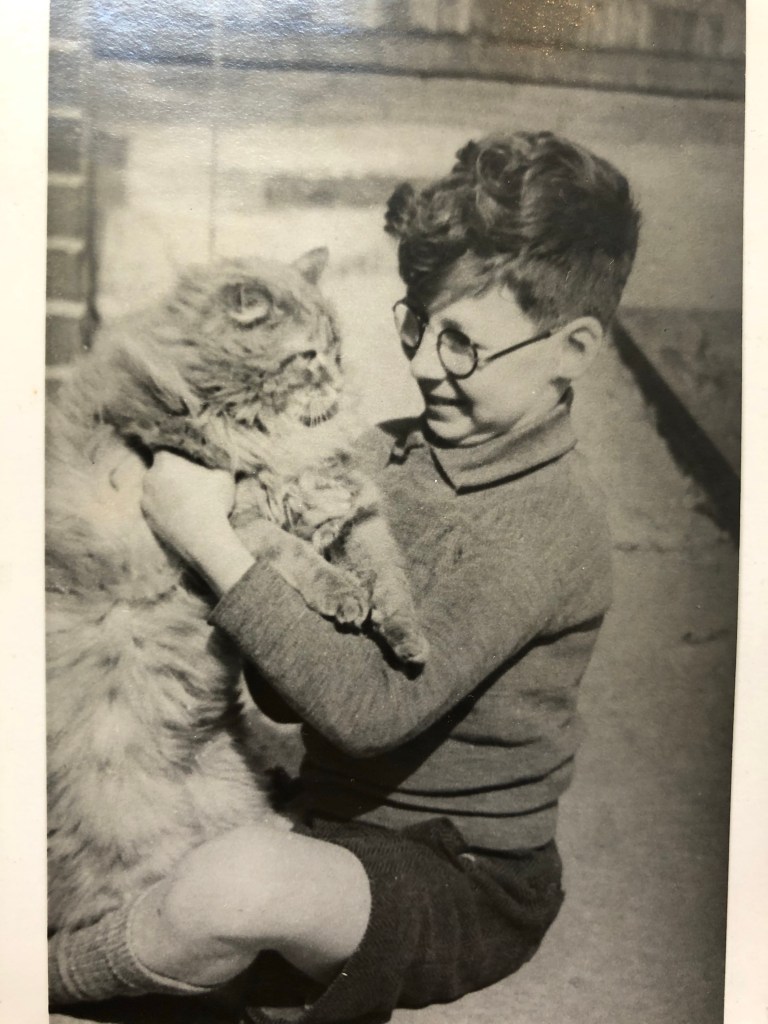
Mickey was also the most prolific mouser of all our cats, and he would very often bring dead, or not dead, mice home, for us to appreciate and admire. Occasionally he also managed to catch a bird. The end came for Mickey after Jimmy was born in April 1947, and one day Mickey was found sleeping in the pram where Jimmy was asleep. We’d heard stories of babies being suffocated by cats sleeping on them, so then Mickey had to go. My mother took him to Jones’s’ Stores, where he became the warehouse cat. He disappeared from there a year or two later. Michael Fish and I wandered all over Darwen searching for him but never found him.
The next pet that I shared my home with was Sandy, who we got from Cookham soon after we arrived in Maidenhead, so in 1971 or 2.
So much for pets.
2/ Music
Just today, 8 July 2014, Johnny asked me to write about the music in my life so that he could listen to it on Spotify, but now we’re still pre-1948, so it won’t be Jimmie Noone just yet. The music talk at home was very Vienna centred, my mother and her parents talked fondly of the Viennese greats, Haydn, Mozart, Beethoven, Schubert… and the music of the Strausses, operetta, and waltzes and polkas.
The music that I heard on records was mainly popular songs that my parents bought, just a handful, three or four dozen perhaps, Austrian and British, Begin the Beguine, Indian Summer , medleys by Charlie Kunz… There was an album holding my parents “best” records. Ditto on the radio, mainly popular music. I also had records of nursery rhymes, songs from Disney films, Snow White, Pinocchio. As I’ve mentioned there were a couple of Austrian records of music by Bach.
At school, music was mainly singing folk music, sea shanties, as I’ve mentioned. I liked everything very much.
We got a fairly reasonable upright piano early in the war (the make was Leffler), and my granddad practised some of the things he would play in the evenings in pubs on it. There was a big pile of popular sheet music in the house, so my grandfather must have accumulated it in his efforts to be able to play the requests that he got when playing in pubs. Sheet music was expensive, so I don’t think he could have afforded to buy much; people must have lent/given it to him.
I started piano lessons when I was about eight, and my teacher was a Mrs Thomason who lived just down the road. (It was in the Thomason garden that I got my arm broken). I did quite well and there was always a conflict inside me, wanting to practice and be really good and wanting to go out to play. But while I was learning with Mrs Thomason, maybe three or four years up to 1947, I did make steady progress, and I could always play something that I had recently learned reasonably well when asked. I never heard of anyone doing piano exams at that time. I played simple Bach, Beethoven, Schubert, Mozart, Clementi; There’s still some of that music in our cellar, (“Bach for beginners”, etc.)
And here’s a story I’ve just remembered. Once I was walking up Earnsdale Road, (which leads to Earnsdale Avenue and is quite a steep hill; I never managed to cycle up it, even when I was eighteen and super-fit). I was with my grandfather, and Mr Thomason overtook us in his car. Alan Hull was walking up the hill a short way in front of us, and Mr Thomason stopped to give him a lift home. My grandfather asked me to run up and ask if they’d also give him a lift, so I went running up to the car, calling, “Wait for Grandpa.” They took one look at me and then drove away, and later I heard Alan tell the story a few times, of me calling “Wait for Grandpa,” and them just driving off, as if it was the funniest thing ever.
The only other thing is to say a few words about Blackburn International Club at this point. During the war, the members were mainly refugees, mostly Jewish, mostly German speaking, plus English people who were interested in meeting them and welcoming them; some school teachers, some Jews… but a bit of all sorts. The club met twice a week on Wednesday and Sunday evenings in a rented hall with a stage and kitchen, and the members just, so it seems to me, drank tea or soft drinks, played games, card games, chess, etc., and chatted. Maybe 30 or 40 people.
And … once or twice a year, they put on a variety show. Mostly it was in the form or a national evening, an Austrian Evening, a Hungarian/French/Italian/American/etc. Evening. They also did other things such as “A Continental Wedding”. It was always put on under the heading “Café Continental”. There was a popular song with that name, and they adapted the words to suit what they were doing. And there was always a lot of singing and dancing, and the star was always my mum, and the music was provided mainly by my grandfather, and a fair few costumes were sewn by my grandmother. In the Continental Wedding, my mother was the bride and she sang, “This is my lovely day”, for the Austrian Evening she sang songs from the Fledermaus (“Mein Herr Marquis, ein Mann wie Sie…”, Adele’s aria from Die Fledermaus, not easy at all), for the French Evening she sang “Il était une bergèr-e, et ron, et ron, petit patapon. Il était une bergèr-e qui gardait ses moutons, ton, ton. Qui gardait ses moutons.” Etc, etc, etc… I could go on!
And… at the Continental Wedding, I recited “Christopher Robin is saying his prayers”… and at one of the other evenings I had to act a sketch with a very pretty girl called Marjorie, (who was much better than me at darts), and finished with us singing a duet, “Did you ever get that feeling in the moonlight?” We were directed in the sketch by a young English girl/woman called Winnie Booth, who was always very kind to me, and who was later the first unmarried mother I ever met.
There’s a programme of one of the national evenings in existence somewhere; I’ll look it out and scan it for you. And in one of the photo albums, there’s a cast photo from the Continental Wedding.
The bridegroom is a woman in top hat and tails, English, Jewish, called Norma, who later married one of the Austrian refugee chaps called Ernst David, so then she was Norma David. And Norma’s mother was called ???? I think just Mrs Netreval (or Netrval), I’m blank otherwise, a very, very Lancashire woman. You’ve heard me talk about Mr Netreval, they really were a most improbable couple. He came to the UK from what became Czechoslovakia, during the first world war, and he wanted to volunteer to fight for the allies. But unfortunately ??? or who knows? fortunately, for him, it became known that he was a tailor by profession, and he spent the war not fighting the Hun, but making kilts for a Scottish regiment. Mr Netreval worked as a tailor at the Co-op men’s outfitters in Darwen for years after the war, and much later, he restyled my DJ which I’d bought in 1952/3 for £17 of my own money, the first article of clothing I paid for myself, so that re-styling must have been done in the early 1960s, ten years later.
But Mrs Netreval was also one of the stars of Café Continental, and no matter if it was Czech or Italian, she sang English music hall songs, it seems to me, very well, “Where did you get that hat?, “You called me baby doll a year ago”, “My Grandfather’s Clock”… And since then I’ve always really liked music hall songs. All of which is to say, I heard and enjoyed a lot of music at Blackburn International Club.

 Greenwood family history